Sunday, September 13, 2015

IN + OUT RECORDS RELEASED NEW MUSIC BY RON CARTER & SUN RA ARKESTRA

My Personal Songbook is jazz bassist Ron Carter’s new album just out on In + Out Records. On the album, Carter teamed with the WDR Big Band, which is based in Cologne Germany, and the winner of seven Grammy awards. Carter and WDR play ten compositions he wrote years ago. The bassist association with the WDR goes back to 2013 when they toured cities in Germany and Switzerland. The tour was successful, and soon after Carter and WDR made My Personal Songbook, a nearly flawless big band album that puts the zoom lens on what a terrific composer Carter is. His reputation as an iconic jazz bassist is well-known. He’s played on 2,000 plus albums, steered Miles Davis’s second great jazz quintet, and made jazz classics such as Where, Yellow and Green, and Piccolo. WDR was the right fit for Carter’s music, adding to it their special seasoning, particularly on standouts Ah, Rio, Blues for D.P., and Wait For The Beep. My Personal Songbook comes with a companion DVD, so you get to see how this project evolved. 

May 22th 2014 was Sun Ra’s 100th birthday. To celebrate it, the current makeup of the Sun Ra Arkestra flew to Istanbul and made this live album Live in Babylon, which came out nationwide September 4th. Sun Ra, a way-out showman, formed the Arkestra in 1953, and the free-jazz ensemble made in the neighborhood of 100 albums. After Sun Ra passed in 1993, saxophonist John Gilmore ran things. Two years later, the Arkestra’s current leader alto saxophonist Marshall Allen became the leader. At 91, Allen is still kicking much ass. Live in Babylon is an awesome tribute to Sun Ra, who for his otherworldly strangeness made some excellent free-jazz music. The Arkestra’s open a Costco size jar of whoop-ass on selections like Saturn, Carefree #2, and Satellites Are Spinning. Baritone saxophonist Danny Ray goes balls deep on the album's best track Discipline 27B, which also have crazy sweet solos by trumpeter Cecil Brooks and tenor saxophonist James Stuart. There’s extraordinary singing by Tara Middleton on the Arkestra’s reworking of the standard Stardust. The album’s linchpin, however, is Allen.  To this very day, his playing is still inspired and youthful

Monday, September 7, 2015

TERRIFIC DETROIT JAZZ FEST SETS FROM CHARLIE HADEN LIBERATION MUSIC ORCHESTRA & OLIVER LAKE ORGAN QUARTET

Oliver Lake

The late jazz bassist Charlie Haden formed the Charlie Haden Liberation Music Orchestra in 1969 and outfitted it with some of the leading free-jazz lions of that era trumpeter Don Cherry, saxophonist Gato Barbieri, and pianist Carla Bley.  The orchestra’s self-titled debut album was suffused with aggressive protest music. Haden’s mission statement for the orchestra was, “This music is dedicated to those who will dream of a society with compassion deep creative intelligence, and respect for the preciousness of life for our children, and for our future”.

At the JP Morgan Chase Main Stage Sunday evening Haden’s wife, Ruth, reiterated Haden’s vision for the orchestra before she introduced CHLMO’s members and ran down the set-list. Presently the CHLMO has many great musicians such as bassist Steve Swallow, drummer Matt Wilson, and trombonist Curtis Fowlkes. Pianist Carla Bley runs the orchestra.

Sunday evening performance was my first time experiencing the orchestra live. The performance wasn’t what I’d expected. I wasn’t in any way disappointed. I loved the music, and Tenor saxophonist Malaby and guitarist Steve Cardenas can count me as a new fan of theirs. I expected a set of aggressive protest music. 

“This Is No America,” “America the Beautiful,” and “Amazing Grace” were some of the songs presented. On every selection, the members played from the deepest regions of  their hearts. I was damn near in tears listening to “Amazing Grace,” which had some mood changes, and “Lift Every Voice and Sing”. The moment that stuck to my ribs occurred when the horn section parted, and the spotlight hit Matt Wilson as he put his drum kit through a cardio-like workout.

***

The Oliver Lake Organ Quartet has one foot planted in the avant-garde jazz, and the other foot rooted in straight-ahead jazz. The quartet played both styles. A blind person could see Lake designed this organ quartet, which almost blew up the Wayne State University Pyramid Stage Sunday night, around organist Jared Gold’s chops. Gold is the quartet’s life force and deserves major props because he pushed the quartet to the brink. Trumpeter Freddie Hendrix deserves much love also
 
Hendricks hands down was the crowd favorite. He hung out in the upper register of the trumpet on most of the tunes. During several solos, he nearly blew the moon out the sky. Lake has been a star avant-garde alto saxophonist for decades. He proved solo after solo, Sunday night that his chops are still mint after all these years on the frontline, and his improvisation has a youthful exuberance. One of the highpoints of the quartet’s terrific show happened mid-way through a song. Lake surprised the audience by reading a poem he wrote titled “You Look Marvelous” dedicated to the late poet Amiri Baraka.

Sunday, September 6, 2015

MEMORABLE PERFORMANCES AT THE DETROIT JAZZ FEST FROM BRIAN BLADE & RENE' MARIE

Rene' Marie
Michael Jewett, the jazz radio personality for WEMU, told the audience at the JP Morgan Chase Main Stage Saturday afternoon that Blade was the most dynamic drummer in jazz. The performance was Blade’s and his Fellowship Band first time playing the Detroit Jazz Festival. Blade has played the festival many times as a sideman. Two songs into the performance Blade had proven that Jewett wasn’t bullshitting the audience about Blade’s status in jazz. 

Blade had to stop playing in the middle of the third tune because he was playing with such reckless ferocity he broke the pedal of his bass drum. That mishap didn’t stop the Fellowship – saxophonists Melvin Butler and Myron Walden, pianist Jon Cowherd, and bassist Chris Thomas – from pushing the composition forward while Blade got it together. Blade is the driving force behind the Wayne Shorter Quartet, and Blade’s go-for-broke-mentality has carried over into the music the Fellowship makes. 

Honestly, the Fellowship sounded a lot like Shorter’s quartet. The likeness is attributable to the abstract manner in which the Fellowship swings. During the Fellowship’s set, there’re many highlights. The one plenty people in attendance will wake up Sunday morning thinking about is Walden’s solo on the third number. Walden wolfed down the chord changes like breakfast cereal. Butler was on, too. He played a solo so hot and humid I thought his tenor would melt in his hands before the completion.

***
The Steve Turre/ Rahsaan Roland Kirk 80th Birthday Celebration Band set was the one I was most anxious to experience Saturday. The band performed some of Kirk’s well-known material such as “Bright Moments,” “Inflated Tears,” and “Theme for the Eulipions”. And the Birthday Celebration Band was stocked with some of my favorite jazz musicians alto saxophonist Vincent Herring, pianist Xavier Davis, and saxophonist James Carter. 

Two numbers into the set, however, I was ready to split. Carter, an exciting multi-saxophonist, who’s at his absolute best fronting his band, seemed out of sorts playing the flute on “Bright Moments”. The band didn’t click right away. That changed when vocalist Naima Shambourger sang “Theme for the Eulipions”, Shambourger shifted the momentum of the set, and got the crowd excited, Then Turre called “Travon’s Blues,” the standout cut from his most recent album “Spirit Man”.  Given all the star power in this band, it took the band nearly half the set to get it together.
                      
***
My plan was simple. Catch half of jazz vocalist Rene’ Marie’s set at the Wayne State University Pyramid Stage, shoot over to the Carhartt Amphitheater Stage to hear some of the Maria Schneider Orchestra,  and then finish out  Saturday night at Kenny Garrett’s hit at the JP Morgan Chase Main Stage. Suffice it to say, my plan didn’t pan out because after Rene’ Marie and her terrific rhythm section – pianist John Chin, drummer Quentin Baxter, and bassist Elias Bailey – got going I couldn’t tear myself away from Marie’s concert. 

Marie sang six songs two from her Grammy-nominated album “I Want To Be Evil: With Love to Eartha Kitt” and three songs from an upcoming album “The Sound of Red”.  Marie threw in a Temptation classic for good measure. The classic was “Just My Imagination,” and that classic set the audience off. Marie sang it so beautifully Eddie Kendricks, the Temptation who immortalized the song, would’ve been envious. 

Marie is masterful at getting an audience on her side and keeping them spellbound. She has a voice that could give God goose bumps. A big part of her magic is a knack for putting together the right band. Marie’s was the draw, but she gave the lion share of the spotlight to John Chin, who had smoke coming from the tips of his fingers at the completion of the performance. Marie had the audience so fired up they wouldn’t disperse until she sang an encore.  

Thursday, September 3, 2015

FIVE MUST-SEE ACTS AT THE 2015 DETROIT JAZZ FESTIVAL

Christian Scott
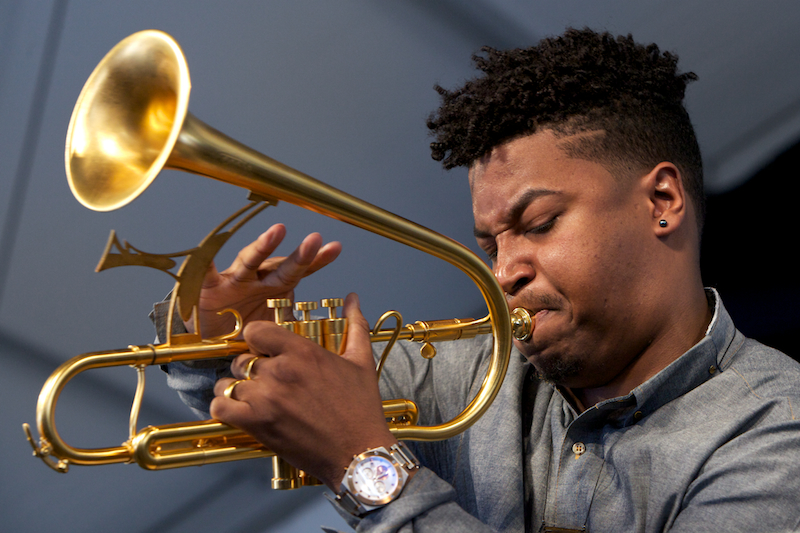
Trumpeter Christian Scott isn’t a stranger to the Detroit Jazz Festival. The native of New Orleans got a taste of the fest at age seventeen playing in alto saxophonist Donald Harrison's band. Back then, Scott was a clean cut trumpet savant, with the history of New Orleans variety of swing flowing through his trumpet. Scott is 32, now, has made eight albums as a leader and two albums as a co-leader, and he’s one of the top jazz experimentalists of his generation. The music that he’s been putting out the past decade is an amalgamation of jazz, hip-hop, and rock. Scott’s music hasn’t gone over well with many of New Orleans's elder jazz musicians. Scott goes into detail about the chastisement he’s received in the liner notes to his excellent double-disc Christian a Tunde Adjuah, a recording that shows the breadth of his chops and the depth of his imagination.  Scott’s latest twist on jazz is called Stretch Music, which surely he’ll breakdown during his set.
Christian Scott Stretch Music Monday, September 7th Wayne State University Pyramid Stage 6:15 pm-7:30 pm
Rene Marie
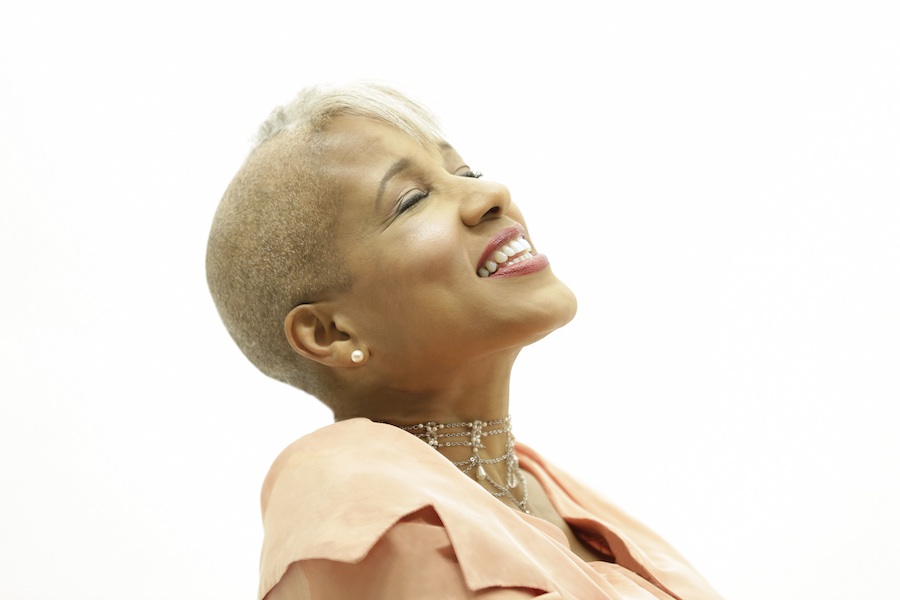
Jazz vocalist Rene Marie sings Saturday evening at the Wayne State University Pyramid Stage. It marks her Detroit Jazz Festival debut, but it isn’t her first time performing in Detroit. A little over a decade ago, Marie played twice at the Serengeti Ballroom in Detroit. The jazz writer for the Metrotimes caught Marie’s first show, and he documented the following: Rene Marie knows how to get inside the marrow of a song. At her concert, she floats around the bandstand. She hovers over her pianist, lands next to her bass player leans her head on his shoulder while he feeds her pieces of the melody. People flock around Marie because she includes them in the performance.” When that was written, Marie was beginning to build her brand. As the story goes, she’d walked away from a secure and good paying profession and jump headfirst into her passion singing jazz. Marie sings her beautiful ass off whether singing a ballad, swing, or a politically themed song. Marie’s voice is in the same league as Ella Fitzgerald’s and as Carmen McCrae’s. Marie, 59, is a native of Warrenton, Virginia. “How Can I Keep From Singing” and “Voice of My Beautiful Country” are I Dig Jazz favorite Rene Marie albums.
Rene Marie “Experiment in Truth” Saturday, September 5th at the Wayne State Pyramid Stage 8:45 PM-10:00 PM                                                                                                                 
Rudresh Mahanthappa
Alto Saxophonist Rudresh Mahanthappa, I Dig Jazz’s favorite alto saxophonist,  has a fantastic album on the market titled Bird Calls. The original compositions have traces of Charlie Parker’s spirit. The thing is; Mahanthappa swears up and down Bird Calls is not a Charlie Parker tribute album. Mahanthappa, 44, is a graduate of Berklee College of Music, and he gained national attention collaborating with pianist Vijay Iyer.  Mahanthappa cites Parker as a significant influence. Bird Calls is one of the best jazz albums I Dig Jazz has listened to this year. Mahanthappa’s band Adam O’Farrill, Matt Mitchell, Francois Moulin, and Rudy Royston will play the music from this album at the Absopure Waterfront Stage. Surely, Charlie Parker’s spirit will be on the bandstand.
Rudresh Mahanthappa “Bird Calls” Saturday 5th Absopure Waterfront Stage 5:45 Pm-7:00 PM
Brian Blade

He’s been the driving force behind the Wayne Shorter Quartet short of two decades. His name is Brian Blade, and he’s a drummer. He’s 45, hails from Shreveport, Louisiana, and his resume includes work experience with bands led by Kenny Garrett, Joshua Redman, Joni Mitchell and Bob Dylan. The best way to describe Blade’s style of drumming is to think of a mad scientist mixing drummers Art Blakey’s DNA with Ed Blackwell’s DNA. When Blade is not and touring with Shorter’s quartet, he’s the CEO of his very own jazz dynasty called the Brian Blade & Fellowship Band. To date, the band has put out four albums. Landmark is the most recent. Keep your fingers crossed Blade will call cuts from Landmark in the set-list the Fellowship’s performance Saturday afternoon at the JP Morgan Chase Main Stage. The Fellowship band isn’t your conventional post-bop jazz band. The variety of jazz the band is into is thought-provoking, the kind of music a group of jazz musicians with the souls of intellectuals could manufacture.
Brian Blade & Fellowship Band Saturday 5:00 pm-6:15 pm at the JP Morgan Main Stage
Steve Turre
The late saxophonist Rahsaan Roland Kirk 80th birthday was August 7th. Kirk was a colorful jazz musician who could play several reed instruments simultaneously, and Kirk had a proclivity for being comical and militant. In celebration of his birthday, trombonist Steve Turre assembled the Steve Turre/ Rahsaan Roland Kirk Birthday Celebration Band. The band has been touring nationally. Saturday evening the band, which includes pianist Xavier Davis, saxophonist Vincent Herring, drummer Gerald Cannon, and bassist Dion Parson, will hold court at the JP Morgan Chase Main Stage.  Turre added extra muscle to this band having saxophonist James Carter as a special guest. The Birthday Celebration Band is a dangerous group with Turre, Herring, and Carter on the frontline. It’s advisable to wear a hard-hat and safety glasses during this performance.

The Steve Turre/ Rahsaan Roland Kirk Birthday Celebration Band w/special guest James Carter Saturday 6:45pm-8:00 pm at the JP Morgan Chase Main Stage 

Sunday, August 30, 2015

PAT METHENY, THE 2015 DETROIT JAZZ FEST'S ARTIST-IN-RESIDENCE, LOVES DETROIT

Pat Metheny
Guitarist Pat Metheny has headlined jazz festivals internationally during his storybook career. At many festivals outside the United States, Metheny was the artist-in-residence. Surprisingly, Metheny has never served in that capacity at a jazz festival in the states. When asked to be the 2015 Detroit Jazz festival artist-in-residence, Metheny accepted enthusiastically.

The past five years, the Detroit Jazz Festival artist-in-residency has become a prestigious post. Regina Carter, Christian McBride, John Clayton, and Joshua Redman were big-name jazz musicians who held the residency. Metheny, however, is the most celebrated and accomplished.

Metheny is already a jazz legend. The man has made a whopping fifty plus albums, won 18 Grammies, and has been a principle influence of a legion of guitarists from various walks of music. I Dig Jazz wanted to get Metheny’s take on the Detroit Jazz Festival and a few of his fondest recollections of performing in Detroit.

When you're asked to be the 2015 Detroit Jazz Festival’s artist-in-residence, were you gung-ho about accepting the gig, or were there some reluctance?

I was pretty gung-ho. I have had a role like this many times over the years, but always outside of America. This is the first time I was asked to do anything like this here in the States.  Because Detroit is so special to me in so many ways, I was thrilled and honored to be asked.

How does the Detroit Jazz Festival stack up to other high-profile jazz festivals you have headlined?

I have been lucky to be able to travel so much over all these years, and I think I have played on just about every major jazz festival, many of them on multiple occasions. It has been really exciting to watch the Detroit festival emerge as one of the best festivals in the world, and one with a very unique vibe that could only happen in America, and in fact, only in Detroit. 

This festival is distinctly different from all the European festivals, as great as they are. Because of Detroit’s particular place in American history and the amazing way that the city has been represented in music by the wide and deep array of musicians who have come from Detroit, there is an equal kind of wisdom and insight into the music to be found in Detroit audiences as well. 

Add to that the excellent world-class programming that has become the hallmark of the festival in recent years and the truly stunning fact that the concerts are free to the public, and you find a festival that is unlike any other anywhere.

What's your fondest recollection of performing in Detroit?

I have so many great memories. From playing at the Punch and Judy theatre very early on (one of the first places to give me a gig as a leader actually) to the 80/81 band at Baker’s Keyboard Lounge to all those many hot and sweaty summer nights out at Meadowbrook with my own groups to playing with Joni Mitchell at Pine Knob to all the fantastic concert experiences downtown at the Fox, the State, Orchestra Hall, the Music Hall to live on DST and on and on. And as I have noted along the way, I have never had a bad gig in Detroit, the audiences are always inspiring and great to play for.

 Are there any Detroit jazz musicians you’re dying to work with?

Ron Carter is at the top of the list. Although we have played together occasionally in various settings, playing a duet concert with him as we are doing is something very special. He is one of my real heroes in life.

If you’re going to be a spectator at this year’s jazz fest instead of its artist-in-residence, what performers would you be anxious to check out?

It is such an incredible line-up. I would definitely be there to hear James Blood Ulmer. It is great that my brother John Scofield is playing again with Joe Lovano for a tour. They are a classic combination. I have known Brian Blade since he came on the scene, and he has often spoken about how much of an influence my group was on his Fellowship Band and I would definitely go see them if I could.

 I knew Carmen Lundy back in Florida when we were both starting, and I don’t think I have seen her since then - I would love to check out her set. Christian Scott is another younger musician I have followed from the beginning of his career and is a super talented musician with a real authentic voice. There is so much great music to be heard at this festival.

Sunday, August 9, 2015

TERRIFIC NEW ALBUMS BY THE ALL-STAR QUARTET, HEADS OF STATE & PIANIST AARON DIEHL

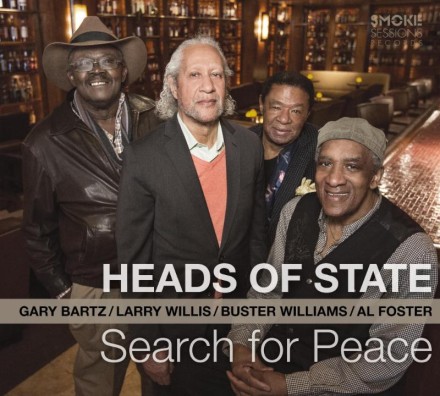
Heads Of State is a recently formed all-star jazz quartet. The members are saxophonist Gary Bartz, pianist Larry Willis, bassist Buster Williams and drummer Al Foster, four of the classiest jazz musicians working. They came together, as the story goes, last year for a one-time only engagement at New York’s Smoke Jazz & Supper Club. The evening was magical, and a week after that Willis pitched keeping the band together, which Williams, Bartz, and Foster were up for.

Initially, the quartet was billed the Larry Willis All-Stars, and the quartet's first high-profile gig was a three-day concert tribute to NEA Jazz Master McCoy Tyner. Some of the compositions performed at the tribute are on this album. The quartet’s name was changed to Heads OF State, and in January the quartet recorded Search for Peace, an excellent ego-less swing session, which Smoke Session Records released in July. 

This quartet is tight as a banjo string. On Impressions, Uncle Bubba, Soulstice and I Wish I Knew, each member uncaged their inner-swinger. Heads Of States is a democracy. Each member is accomplished and influential. However, Bartz's chops power the quartet. His solo on Crazy She Calls Me has a celestial warmth. And on medium tempo selections there's a gentlemanly air to his blowing.


Space Time Continuum is Aaron Diehl’s follow-up to his major label debut The Bespoke Man’s Narrative on Mack Avenue Records. The 27-year-old Ohioan is a refined pianist/composer a la John Lewis. Diehl gained prominence in 2012 after winning the prestigious Cole Porter Fellow in Jazz Competition. 

Diehl staffed Space Time Continuum with special guests saxophonists Benny Golson, Joe Temperley, Stephen Riley, trumpeter Bruce Harris and vocalist Charenee Wade. 

Wade bears a striking resemblance to Grammy-nominated jazz vocalist Cecile McLorin Salvant who's musically Diehl's kindred spirit. Wade is phenomenal, and it's unfortunate Diehl didn't carve out more showtime for her. 

The nine original compositions Diel included on Space Time Continuum seem custom-tailored for his guests. Golson shows he still has genius level chops on the album’s best cut Organic Consequence. Temperley, a titan of the baritone sax, put a veteran swinger’s touch on The Steadfast Titan. Diehl is a jazz pianist who rarely color outside the lines, but what he does inside the lines is awesome.

Sunday, July 26, 2015

SAXOPHONIST DE'SEAN JONES EXPOUNDS ON WHAT INSPIRED HIS DEBUT 'KNOMADIK REVERENCE'

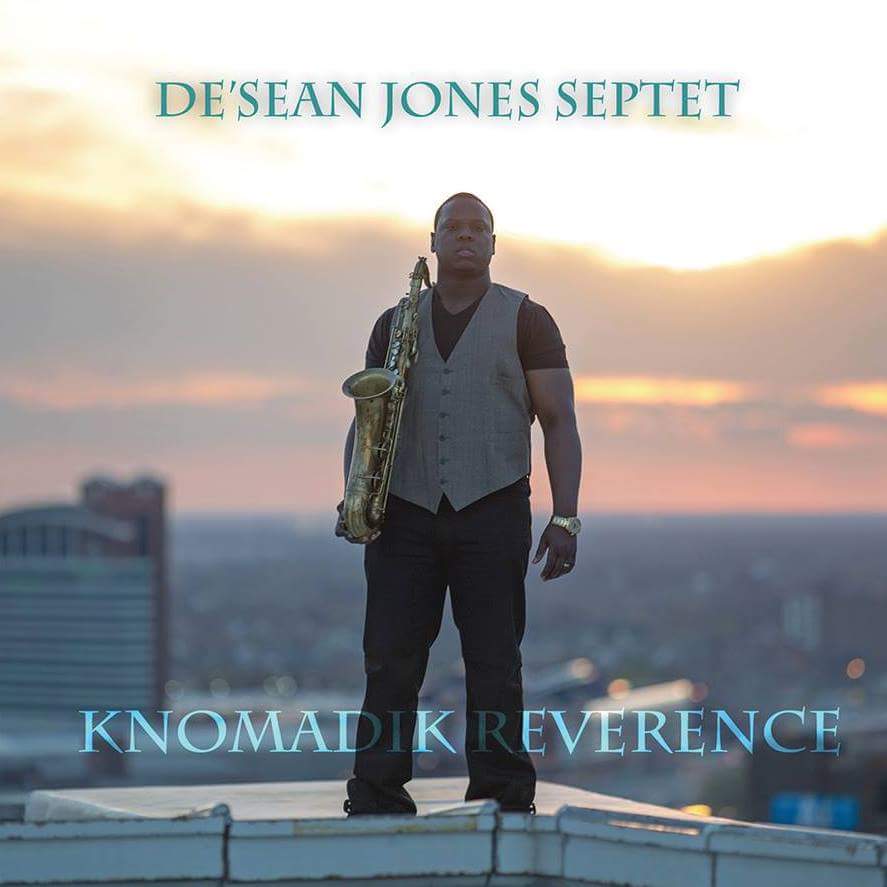
The saxophonist De’Sean, 27, is like many jazz musicians of this generation such as bassist Ben Williams, pianist Gerald Clayton, trumpeter Christian Scott, and vocalist Esperanza Spalding. They refuse to be typecast. They are influenced by hip-hop, gospel, rock, neo-soul, and techno, and the musicians mix those genres with jazz. Jones’s debut album Knomadik Reverence on Detroit Music Factory is an example of the fusion a growing number of  musicians in Jones’s age demographic are into. Knomadik Reverence is a hybrid of jazz, techno, and elements of rock demand that listeners be open-minded.

Jones, a native Detroiter, received invaluable on the job training from jazz greats bassist Rodney Whitaker and the trumpeter Marcus Belgrave. Jones has also worked with the Gerald Wilson Orchestra, and Underground Resistance, a techno band Jones toured internationally with. Since 2011, Jones has been building a brand wit his band Knomadik. The saxophonist took some quality time to answer questions about Knomadik Reverence, and to talk about his evolution as a musician.   

Explain the album’s title?

The title of my album is directly inspired by my spiritual beliefs, life experiences and my band Knomadik, which I formed in Chicago around 2011 while on a music outreach tour. As a musician, I've definitely had a nomadic lifestyle, traveling extensively, engaging with different cultures and styles of music the world over. After a while elements of those experiences, and perspectives tend to stick with you.

What I've realized is that we all borrow from one another in some way, and that's what I wanted my music to reflect. The life of a musician is both beautiful and extremely challenging, so when I fully committed to the lifestyle of an artist I had to have faith that things will work out in my favor.
In life, nothing is promised, and I accept that which is why I place my complete trust in God. Knomadik Reverence is just a brief summary of what I had experienced in life up to that point.     

What inspired Knomadik Reverence?

At the time, I started composing this music I was going through many changes in my adult life. I was in my early 20's, raising a family, trying to get through school, and still actively touring with Marcus Belgrave and Detroit Techno legends Underground Resistance Mike Banks and Jon Dixon. I was in desperate need of an outlet and of course, I channeled all those thoughts and emotions into my compositions.

Ultimately, what proved to be my muses were these three to five-hour trips on the Greyhound from one gig to the next. I guess it gave me the time necessary to sort through my ideas. Frankly, there was nothing else better to do on a Greyhound anyway.

If a layman pressed you about the music on this album, how would you describe the music?

I would definitely say this album possesses high energy and compositions pulling from a wide range of styles gospel jazz, hip-hop, and rock. Ultimately, I think this music is best served live because there is an element of the unexpected that also comes with this kind of musical presentation. The element of surprise is something I think many people can definitely appreciate.

You started out playing straight-ahead acoustic jazz when and why did you transition into jazz fusion?

Well, one of the great misconceptions about me early on was that I was strictly a jazz saxophonist. My first love musically came from the church, and that has always been the heaviest influence on me musically. Unfortunately as a saxophonist, that particular instrument is so unconventional within the gospel idiom that you have to find other outlets.

Ultimately, I believe there was a divine purpose for me to being, 14, and being mentored by the likes of Marcus Belgrave or Rodney Whitaker, and Roger Jones, who is a phenomenal gospel / jazz keyboard/organist and composer. 

My desire was always to be as well rounded a musician as possible. So I would never limit myself to being a specific type of player because in the end that's dishonest to all the music that has influenced me over the years.

When you really think about it, it’s hard to imagine anyone from the city of Detroit only playing one style of music when we have such a deep and rich history of Motown, gospel, rock, jazz, and techno.

Have you received any flak for not staying with straight-ahead jazz given you studied with greats like Rodney Whitaker and  Marcus Belgrave?

To be honest with you I have no idea if people disagree with my musical choices, and even if I did, I wouldn't care because the notion of sticking with one style of music is laughable. It's 2015 people!
I find it hard to believe that people even still think like that nowadays. Marcus Belgrave, Rodney Whitaker, Lawrence Williams, and even Donald Walden never pushed me to be a jazz, musician. They only pushed me to reach my full potential, which is what I am continuously striving towards. 

De'Sean  Jones
Some of your peers have used crowd funding to fund their debut albums. Why did you go the conventional route?

This industry has truly turned into a DIY business. So, with the emergence of crowd funding and various ways to produce and distribute your music independently, it only makes sense for all of us to consider that as a viable option. The only reason I went this route with a label was the opportunity presented itself. I'm very thankful to Gretchen Valade and the Mack Avenue family for even considering signing me because there are so many talented artists out there they could have easily signed and released a project with. I feel extremely fortunate to have this opportunity, and I recognize there is a responsibility on my shoulders to remain focused, continue to push music I believe in, and represent the city of Detroit.

To date, Knomadik Reverence is the most experimental album Detroit Music Factory has released. How tough was it convincing the label to make this album?

There was no convincing at all, and the initial response was extremely positive when they heard the project. I think the label and people, in general, are just eager for many different kinds of music that's exciting, and still has something of a soulful resonance to it. Hopefully, when people check the album out, they will enjoy the experience.

At 27, you are one of the youngest jazz musicians signed to the label. Do you view yourself as sort of a catalyst for Detroit jazz musicians of your generation to test-drive the label?

I do not take this opportunity or my position within this opportunity for granted. Whenever I'm on tour, I always tell people I come from a "Pride of Lions," and right now, the torch has been passed by the late great Marcus Belgrave. He was the voice of our community, and he was truly like a father to so many of the artists in the Detroit community. 

All the greats before me and my generation have laid down and incredible musical legacy and foundation for people like myself, Marcus Elliot, Ian Finkelstein, Alex White, Jon Dixon, Ollice “Olle Keys” Cooper, Angela Davis, and a host of others to come out and really take the world by storm. 

We are standing in the shadows of giants and there's a lot of work to be done, but I am proud and honored to be a part of that legacy and to be a part of the continuum of music being released from the city of Detroit.