 |
| Christian Sands |
Monday, December 16, 2019
THE CHRISTIAN SANDS TRIO MAKES BLUE LLAMA DEBUT


Monday, December 9, 2019
THE PARADISE JAZZ SERIES AUDIENCE CONSUMES TWO-HOURS OF DUKE ELLINGTON'S HITS, PLUS HIS NUTCRACKER SUITE
 |
| Duke Ellington |
Sunday, December 8, 2019
WALLACE RONEY ON 'BLUE DAWN-BLUE NIGHTS', USING HIS BAND TO DEVELOP YOUNG JAZZ MUSICIANS, AND WHY MILES DAVIS IS THE G.O.A.T.
 |
| Trumpeter Wallace Roney |
As long as I'm living, as long as I hear music in my head,
I've got to get it out, and that's the key. Just be true to hearing the music
or the sound that's in your head. The other part of it is always trying to take
the music further. One step beyond.
In your bands, you always have veracious young musicians like
Art Blakey had in the Messengers long ago. Why do you staff your group with
such raw talent?
Art Blakey, Buhaina,
we'd call him. He used to do that, but people forget, Miles Davis did it too
with Herbie Hancock, Ron Carter, Wayne Shorter, Jack DeJohnette, Keith Jarrett,
Chick Corea, and Gary Bartz. Those guys were young back then. So, Buhaina and
Miles understood the power of young minds, but it's not just young minds. You
must have a certain young mind, a mind that's willing not to cheat the music,
but take the music forward. That's the kind of young guys I like.
When did you meet Miles, and how did he help shape your playing?
I started loving this music when I was three years old. That
was the kind of music I fell in love with, and when the rest of my little
friends were listening to R& B, I was listening to progressive jazz. And I'm
talking about three years old, and I'm listening to Seven Steps to Heaven. And The Freedom Rider, because that was
the music in my house and that's the music I loved. My father was listening to
it, but he was listening to other stuff, too. But I chose to hear that music,
and in that music, Miles was my hero. Miles and Trane and Ornette and
Cannonball, Horace Silver, and Mingus.
Then I heard Dizzy and Bird, and that blew my mind. So, by
the time I met Miles, well, I was listening to him and following every record
he made. And then, when I became an artist on the scene, I met him when I was
23 years old. I was playing on a retrospective concert for him, when he was
getting his honorary degree. And I played on it along with a lot of his other
alumni and some R& B guys, like Peabo Bryson. And George Benson.
And I was part of a seven-trumpet thing that was doing a
fanfare for him, and we took a couple of choruses of Blue Beach with
the rhythm section of Herbie, Tony, and Ron, and then Mile’s band came on and
played afterward, his latest band with Darryl Jones and Bill Evans.
Darryl had just joined the band, by the way. And Al Foster was in the band, too.
Anyway, afterward, he asked me to come up, and I met him. He said he heard me, he liked what I was doing, and gave me his number to come over to his house. And that's how I met him.
When you and Miles first connected, and when you first
went over to his house, what was the conversation like? Did you guys talk about
music?
Oh, it was about music, but the first thing he said when I
walked into his doorway is, "I never liked Brownie." Clifford Brown.
He said, "It's not that I was jealous or anything, he was a nice enough
guy, I didn't think he played as well as everybody thought. That was the first
thing he said to me.
At the time, you probably were a Clifford Brown fan.
I was a Clifford Brown fan. Miles was still my idol. Still,
my hero. But I was a Clifford Brown fan, you're right. But I wasn't going to
argue with him because I wanted to understand where he was coming from and
learn the lesson he was teaching me, and I'm glad I did.
When you became a well-known bandleader and had a bunch of
acclaimed recordings under your belt, did you ever get tired of the comparison
to Miles, or people saying Wallace thinks he’s Miles Davis.
No. I never get tired of the comparisons to Miles. I get
tired of the critics trying to make it into a negative. Because to me, it's no
comparison. Miles Davis is the greatest ever. What I'm trying to do is continue and push forward from the lessons I learned from him and try to play
this music. I'm not trying to do anything else but play music, you know?
What was the greatest lesson that he taught you that you
still, carry with you today and that you share with the young musicians in your
bands?
To learn everything you can and learn everything about the
music and then be yourself. And that's one thing I think Miles might've liked
about me that the critics or people don't understand. I tried to learn
everything he knew. I didn't try to get just a little piece of it. I tried to
get all of it.
And that's the thing when you learn, and you want to learn
all of John Coltrane. You want to learn all of Ornette Coleman. You want to
learn all of Art Blakey. You want to learn all of Max Roach. I mean, every
little piece, you want to learn every part of Herbie, every part of Elvin. You
want to learn every part of rock music, every part of Mozart. Every part of the chief
orchestrator or chief rhythm guru in Africa. You want to learn everything about
it. Why it works and use it, and then come out and use it your way.
I've seen you in concert many times. You come out, start a
tune, then you go backstage and let the band do their thing. Why do you leave?
I'm listening to shape what the musicians are doing. That's
what I'm doing. I'm still on stage. I get out of their way, but I'm listening
to see where to take the music next. Where I'm going to end the song and where
I'm going to blend it with the next song. From the beginning of the set to the
end of the set is a continuum.
I asked that question because Miles was criticized when he
would turn his back to the audience and play, and the audience felt he was
being a jerk. Miles said the same thing that you just said, that he could hear
the band better and he was trying to figure out some stuff. It wasn't about
that, about being disrespectful to the audience or anything like that.
Right. But with that said, I don't turn my back to the audience, do I?
No, I just noticed
that you walk off stage.
I walk off the stage.
So, people can focus on what's going on instead of looking at me while I'm
playing. But what I'm doing is listening to them and trying to coalesce what
they're doing and what the next evolution of the music is going to be. That's
what I'm doing.
Horace Silver was another significant influence on you
musically. When did Horace come into your musical life?
Well, Horace was an influence on me. There's a lot of people
that were big influences on me. I had auditioned for his band when I was 18. I
didn't get the gig, but Horace said to me, "Man. I could hire you right
now, but I think I would be hurting you." And he taught me to pay
attention to the chord changes in the chords. He said, "I hear what you're
trying to do, but I want you to do it instead of just hitting and missing. In
other words, getting every one of those chords, and if you're going to play off
the chord, understand how to play off the chord, which you try to do."
So Horace really influenced me because I was so hurt I didn't
get the gig, I sat home and I learned every part of the harmonic structures
that I was playing in, and that's why Miles became even more important, because
he really showed me how to take those chords and how to take the notes, and
bend the chords a certain way. He taught me even more than what I was trying to
get to, you know? So, it became a quest to advance what you can do melodically
and harmonically.
After you got your chops together, did Horace eventually hire
you?
No. Only on those
auditions. But Horace was so beautiful. I'll tell you a great Horace Silver
story. I did an audition, and he kept me up there for the week, and he paid for
the hotel, and we talked, and that's when he was telling me things. I'd go in his
room and play for him, and he would instruct me on how to play chords. He’d say,
"Right there. You missed a chord right there."
That was 1978 or 79. And then six years later I was playing
with Tony Williams. And we were playing in a club called the Montmartre in
Denmark. He was there. By that time, man, I had been stretching the
harmonies and trying to go beyond what I had already learned, and I was going
for it.
And Tony was
encouraging me too, and I had been hanging with Miles, and when we got through
that set, Horace Silver jumped on the stage and grabbed me and hugged me. He
said, "Wallace, wow. You played your booty off, man. " And then I
thanked him, I didn't know what else to say.
And then he went to
Tony Williams and started bragging to Tony about me, so Tony comes to me and
says, "Man, Horace was just raving about you." I didn't tell Tony the
story, the beginning- And then one of my friends who was playing with Horace
had told me, "Man, Horace was talking about you. He was talking about when he
first met you and how great he thought you were then, but what you evolved into
now."
What're your thoughts on where jazz is now?
Well, I don't have any thoughts where jazz is now. That's
like saying where life is now. I can say what life is today, but then a million
years from now, it'll be different. So, you must accept where things are. You
can't tell whether it's good or bad, you must live it, you know?
If a young musician says to you, "Mr. Roney, I've
studied your career, and I loved the direction that it's in or it's gone in.
What advice can you give me, so I can have a career that’s like yours, or
better?"
You can't have better. There are two reasons why you can't
have better. Whatever your career is, it is for you. So, it can't be better
than mine because it was for me. So that's number one. You can't have better.
Number two, how are
you going to have better than playing with Miles, being with Miles Davis,
playing with Tony Williams, being with VSOP, playing with Sonny Rollins,
playing with Jay McShann, Elvin Jones. Even people that were my peers never got
a chance to do that. And hang with Ornette Coleman. So how are you going to get
better than that? It's not possible. But even though it's not possible, that's
my life. So, their life, they're going to have to find what's better for them
or what's best for them.
If you studied my career, I appreciate that. I hope there's
something in it that can inspire you. That's what I would say. And I would say
if you ask for any advice play this music because you must. Don't play this
music to become a star. Don't play this music because you think you're going to
make a lot of money. Play it because you must, because you love it.
If you don't become a star, then what? Are you going to quit
the music? Because not everybody's going to be a star, even though they might
deserve it. What if you don't make a lot of money? Are you going to stop? Well,
if you didn't, then you might as well stop it because some people don't make a
lot of money. And so maybe you don't win all the awards. Maybe you don't win
anything. Is that your reason for playing? You got to go deep down and find
that deep reason for playing. If nothing happens, will you still play?
In your experience, how many jazz musicians have that
mentality?
All the great musicians did it for that. Even the ones that
became stars didn't count on being a star. Miles wanted to play with Charlie
Parker. And he kept learning and getting better because he wanted to play with
Bird. He wanted to catch up with Dizzy, he wanted to learn all that stuff Bird
was playing, and Thelonious Monk was playing. It had nothing to do about being
a star, you know.
I don't think Charlie Parker even thought about being a star.
He needed money. But man, Charlie Parker, on his days off, went across the
street to the tavern and played because he had to. John Coltrane never stopped practicing because he heard
something. Other musicians might try to do it because they wanted to be a star,
or they thought of it as a profession, but some musicians saw more of it. And
if you're going to play jazz, it's got to be more than a job.

I had taken these guys, these young musicians, and they come
to my house, and they want to learn, and they want to ask me questions about
these great artists that I played with like Herbie and Tony and Ornette Coleman
and Wayne, and of course Miles and Art Blakey and Elvin Jones and Billy Higgins
and all these people, and I would gladly show them stuff and tell them stories.
We started writing songs, and they'd write these songs, and
I'd start showing them some techniques. And I'm talking about the correlation
between music and all the music in the world, and the next thing you know,
those guys, they became a band just in a very natural way. And they were at the
house all the time rehearsing. And we just went right in the studio, said,
"Let's take it in the studio. Let's try these things."
And it worked out. It flowed very well. And when we would
play, suddenly, there was a beautiful synergy that came from this band.
Unfortunately, my nephew didn't stay in the band because his father felt like
he was better served to play with him than my band.
Emilio Modeste, the saxophone player on the new album, is 19,
and he has an aggressive approach and tone for his age. I heard him in Stanley
Clarke’s band at the Detroit Jazz Festival.
He's one of the original ones that came over and hung around
the house for years.
Are you going to record more with this band?
Let me put it like this. As long as I'm playing music, I will
record with my band, and as long as my band is a band, that will be what's on
the record. And in the same way that Bird did, the same thing that Art Blakey
did with Horace and Kenny Dorham, and then Horace and then Lee Morgan and Bobby
Timmons.
The same that Miles did with him and Trane. Everybody, they have a
band. You record with your band, and you keep recording because you're
documenting the evolution of the music being made. So, if this band sticks
together, there will be another record. If someone leaves for some reason, like
my nephew left, then he must be replaced with the next guy. The music keeps
going forward.
Tuesday, November 26, 2019
JAZZ VOCALIST MICHELLE LORDI EXPLAINS NEW ALBUM 'BREAK UP WITH THE SOUND & HER MUSICAL JOURNEY

Jazz Vocalist Michelle Lordi owns a voice tailor-made for delivering love songs, which was evident in mid-October at Detroit’s Dirty Dog Jazz Café’. She treated the audience to
music from her fantastic discography, including original gems from her new
recording “Break Up With The Sound.” All evening long, her voice was
authentically angelic and inviting enough to make the devil blush. After her
final set, half the attendees lined up to purchase CD’s she was selling. She's from Philadelphia. On the jazz scene
there, she’s a household commodity. Before she started singing
professionally, she worked as a photographer, a product designer, and a medical
device sales rep. To date, she’s released three albums
“eidolon,” “Dream A Little Dream,” and “Break Up With the Sound.” The latter
hit nationwide November 1st on Cabinet of Wonder Productions, and the album shows her in her
natural habitat, performing love songs and backed by a neatly stitched band
drummer Rudy Royston, bassist Matthew Parrish, guitarist Tim Motzer, and
saxophonist Donny McCaslin. She put a new finish on songs by Cole
Porter, Hank Williams, and Mick Jagger. Her four originals are the
best overall. A few weeks after her Dirty Dog performance, she talked to I Dig Jazz about the making of "Break Up With The Sound," getting a late start as a professional singer, and encouragement she’d offer up and coming musicians.
The title is interesting, “Break Up With
The Sound.” What does that mean?
That’s a good question. That's a line in the song “Poor Bird.” And I think I chose that as a title because some people ask, is that a negative thing? Sometimes they're really good things that you need to break up with like people who aren't right in your life. So, what the title is referring to in that song is the idea of being in love with your sadness or being stuck in a spot that is not fruitful. So that's where that came from.
Listening to the album and
hearing you at The Dirty Dog, I believe you have an affinity for love songs.
That’s what stood out to me. Do you consider performing love songs your forte?
I feel like everything's a love song. You know, there are love songs that are about love between two people, and there are love songs to places and love songs to memories, and ghosts. So, yeah, I love to sing, and I love making music with the people I make music with. My whole musical journey is like a love story; just being able to have a life in music is a love story to me.
I've
never thought of it in that kind of context.
Well, I only will sing about things that I that have a good feel for, so you can read that however you want.
Is it true you’ve only been singing professionally for five
years?
I've made an album, like a little demo thing when my oldest son was born, and he's 16 now, but I didn't pursue music full time until about five years ago now.
What did you do before
then?
Oh, a lot of things. I've been a photographer. I’ve been a product designer. I've sold medical devices. I've sold pills legally. I have three kids. So, I had a bit of a road to get to the music.
What was the turning point?
What happened to make you decide to drop those occupations and focus on singing
professionally?
That's a good question. Nerves, I guess. None of it was practical. None of it was easy. For me, I needed to do something full-on, and this is what I wanted to do. It'll be two years ago in December my house burned down. And this whole new album comes out of that experience of losing everything, but nobody was hurt, which was great. But what I lost was a lot of music I hadn't put out. I lost a lot of writing that I had never made into songs. I lost pieces of songs I'd never produced. And this whole album comes out of that experience.
When the dust cleared literally
and figuratively, and everybody was okay, I realized what I had lost is all
those opportunities to get something out in the world. Maybe it wasn't perfect,
but to get it out there and that if you're an artist, it's your job to make
things. I was holding up and not putting things out. This is the first
album with some of my original music.
I've been a student of the American Songbook,
which is great. You could spend a whole lifetime interpreting those songs. But
what I was always driven to do is to write. But I had barely ever done a thing
until the fire.
Honestly, that's the more
significant turning point in this album, which was recorded about a year after
the fire. It's probably the most meaningful piece of art I've ever made. I'm incredibly grateful for what the musicians
on the album brought to the project. And my musical director is also the
producer. That's Matthew Parrish, the bassist. Everybody gave their heart and
soul to interpret my songs and to the way that we did the standards. That's
been like the most significant change or direction for me artistically.
It sounds like it was a
painful album to do, given you had to revisit that period.
No. I think kind of the opposite. As far as losing, you know, we got back on our feet, and we had insurance. So, it was an incredible inconvenience and a year disappeared, but it wasn't as bad as it could have been. But what was lost is all the artistic output that never got out.
I was grieving that until one day I just
realized, okay, so you can grieve it for the rest of your life, a lifetime of
photographs, a lifetime of drawings, a lifetime of music that you didn't get
out in the world, or you can make it again and make it better.
The process of making those songs
was easy and happy because I realized that it wasn't like a one-time thing.
Also, the artwork from the album that's all recent as well. I hadn't made art
since probably my twenties, so it all came together.
How long have you been writing songs?
Oh, my whole life. But like I said, this is the first album of any originals.
Who're some of your musical influences?
Well, first the musicians that you hear on the album. Their music is what I hear. I follow them. I follow their careers. So, they’re my influences because we work together so much. As far as stars from the past, I've always loved Chet Baker and Peggy Lee and of course, Ella Fitzgerald.
.I wasn't exposed to jazz very
early, but once I got into it, I would find a song, and then I'd find every
version of the song, and follow a song from Mel Torme to Ella Fitzgerald and
Sarah Vaughan. The musicians I'm around right now are extraordinary.
Those are my influences because we're creating together. I love country music,
and Patsy Cline, of course, is a beautiful storyteller.
I wouldn't listen to jazz as a kid. I was
listening to punk music and alternative music. But I've been drawn to artists
who are artists like their whole life, like Patti Smith, for example, and Chet
Baker. It wasn’t even his singing that got me. It was his horn playing.
 |
| Michelle Lordi |
You know how difficult it is. We're in the same industry, so you know. But here's the difference is when you know that you have something important that you want to do, it's easy to do, whatever it takes. We could talk for hours about how messed up the music industry is, but that's boring.
So, we all need to figure out as improvisers, how to make something happen, you know, whether it's a side gig or finding a way to connect with your audiences in a way that it's different and gets them to do more than stream your work. Yeah, but I'm right in it. I've got this new album coming out and everything. It feels like everything's changed since the last album.
You know, even how people buy CDs
and, or don't. But I had to do a CD for this album because jazz radio still
demands them. I mean, that's not bad for me because I grew up collecting
records and then CDs. It's comforting to say, "Here's my album," and
have it in my hand, but I know that that's probably just an illusion. CDs don't
sell much.
How do you like performing
in Detroit?
The audiences in Detroit were very kind. I love the Dirty Dog. I have been there before to hear musicians, and I was so grateful to get to play there recently. I love your city. What's the name of the club highly rated for their barbecue?
Bert’s Market Place.
Where else in the world can you walk in and there's like five or six world-class singers just sitting-in. Detroit is such an amazing town. I find reasons to get to Detroit. And I have fun every time. It's always an adventure. And everybody's very respectful that I'm from Philly because we have got a deep musical history here.
I was able to go to some small places in
Philly like Baker's in Detroit, where you could catch Shirley Scott and Mickey
Roker. And I thought that was just what everybody's jazz sounded like. I
felt that all jazz is that good. That's what it felt like walking into
Bert’s
It's like that all the time here. When you go to The Dirty Dog, you'll be surprised who’ll show up. You were lucky the owner, Gretchen, was sitting at the bar enjoying your set.
I've run into her a couple of
times. Talk about somebody who's a fan of the music. It was good to be able to
sing for her, and she was very positive.
I've played at Cliff Bell’s a couple of times before. I love your city.
It feels like a perfect home for artists. I hope it treats everybody well. It’s
wonderful to play in a place with such a history.
If an aspiring artist familiar with your
musical journey wants to quit their job to pursue their art full-time, what
advice would you offer?
I might blow up your interview here, but I would say follow your passion. You find musicians who are a hell of a lot better than you, and you play up to them. You don't ever play down, you know. I have a lot of advice musically on not being afraid and about creating your own opportunities.
I've run a jazz session for five years, every week so that I could play with the best musicians in Philly. Sometimes I don't make a dime. Sometimes I pay to do it so that I could play with certain people on the regular. And it's become a way for people of different generations to connect. It's a way for me to know who's 17 and amazing and who’s 87 and amazing.
So, I would say you can't sit
back and whine and wait. You can't sit back and wait for something to come. You
must make it happen. And if it doesn't work, you must keep going. I don't know
if I could give advice and say quit your job and run off to the circus.
But you could start by developing. You learn
your craft, make a sound, and then find a way to get out and play on the
regular. And it probably means screwing up. I have done that. I've screwed up a
lot.
But then you screw up in new and more
interesting ways next time. I would tell somebody to go and get good at what
they do and find ways to create music in unique spaces that they can get
behind.
Monday, November 18, 2019
THE RODNEY WHITAKER SEPTET PERFORMS ELLINGTON'S MUSIC AT THE DIRTY DOG
 |
| Rodney Whitaker |
If you attend a Rodney Whitaker concert, bank on getting a history lesson on whatever jazz music the bassist's group performs, and as a bonus some comic relief. For 25 years, he’s taught jazz at Michigan State University. No surprise, he uses the bandstand to educate audiences, and his kidding them before introducing tunes is a piece of his musical personality. He’s quick to jokingly warn an audience of his plans to pursue standup comedy when he retires. Saturday evening at the Dirty Dog Jazz Café, the comedic moments of his 90-minute set didn't go over well, which he took in stride. However, the Duke Ellington compositions his septet worked Whitaker's “All Too Soon The Music of Duke Ellington” was a combination of fire and raw sophistication. Whitaker's septet is made up of some of his former and current students such as pianist Corey Kendric, drummer Michael Reed, and baritone saxophonist Len’I Glenn McKinney. The centerpiece was vocalist Rockelle Fortin, Whitaker’s daughter. She’s performed with his various groups since her teen years and has become a world-class vocalist. Her gracefulness, her stage know-how, and her ability to wrap her voice around you like warm scarves beg comparison to the Detroit jazz vocalist Shahida Nurullah. Fortin sang so beautifully on “Mood Indigo” and on “Perdido,” you would've sworn the spirit of Duke Ellington gave her permission to treat his songs as she saw fit. The multi-layered manner Whitaker structured the concert was brilliant, featuring the septet, for example, on three selections. Then showcasing just vocals and saxophone on “Mood Indigo,” and just the rhythm section on “Just Squeeze Me.” Whitaker only soloed a few times. He’s at the elder statesmen leg of his career, comfortable putting most of the workload on the young musicians he’s nurtured musically, and they handled Ellington’s gems like seasoned swingers.
Sunday, October 20, 2019
CHICK COREA'S TRIO PERFORMS MUSIC FROM THE TRILOGY RECORDINGS AT THE UNIVERSITY MUSIC SOCIETY CONCERT
 |
| Chick Corea, Christian McBride & Brian Blade |
The jazz pianist Chick Corea has a knack for getting an audience all hyped before playing a single note of music, sharing, for example, funny anecdotes from his vast and storied career, and in between numbers teasing his bandmates. At Hill Auditorium Saturday night in Ann Arbor, MI, Corea opened his concert by name-dropping Detroit jazz musicians he considers formidable. At Corea’s side was the animated drummer Brian Blade and bassist Christian McBride. In 2016, Corea’s trio played at the Paradise Jazz Series in Detroit. There Eddie Gomez was on bass. The concert was memorable, but Corea’s trio sounds more organic with McBride shouldering the bass responsibilities. The trio performed cuts from the Grammy-winning album “Trilogy,” and the recent recording “Trilogy 2 Live.” The trio could’ve swung a wrecking ball through Thelonious Monks’ “Crepuscule with Nellie,” “Work,” and Duke Ellington’s “In a Sentimental Mood.,” but they showed a level of control and taste expected from such globally accomplished jazz musicians. McBride was the centerpiece. All concert long, he proved he has skills unlike any jazz bassist of his generation. He logged in the most solos — each hand-crafted on the spot for the appreciative audience. Blade, a master jazz drummer tenfold, broke loose on Corea’s “Fingerprint,” As for Corea, the entire concert his playing was sharper than the devil’s tongue, and it was awe-inspiring witnessing him sand the rust off “In a Sentimental Mood” during his solo. The trio was so on point every selection they performed qualified as a showstopper.
Tuesday, September 24, 2019
THE BRANFORD MARSALIS QUARTET OPENS THE 2019-2020 PARADISE JAZZ SERIES
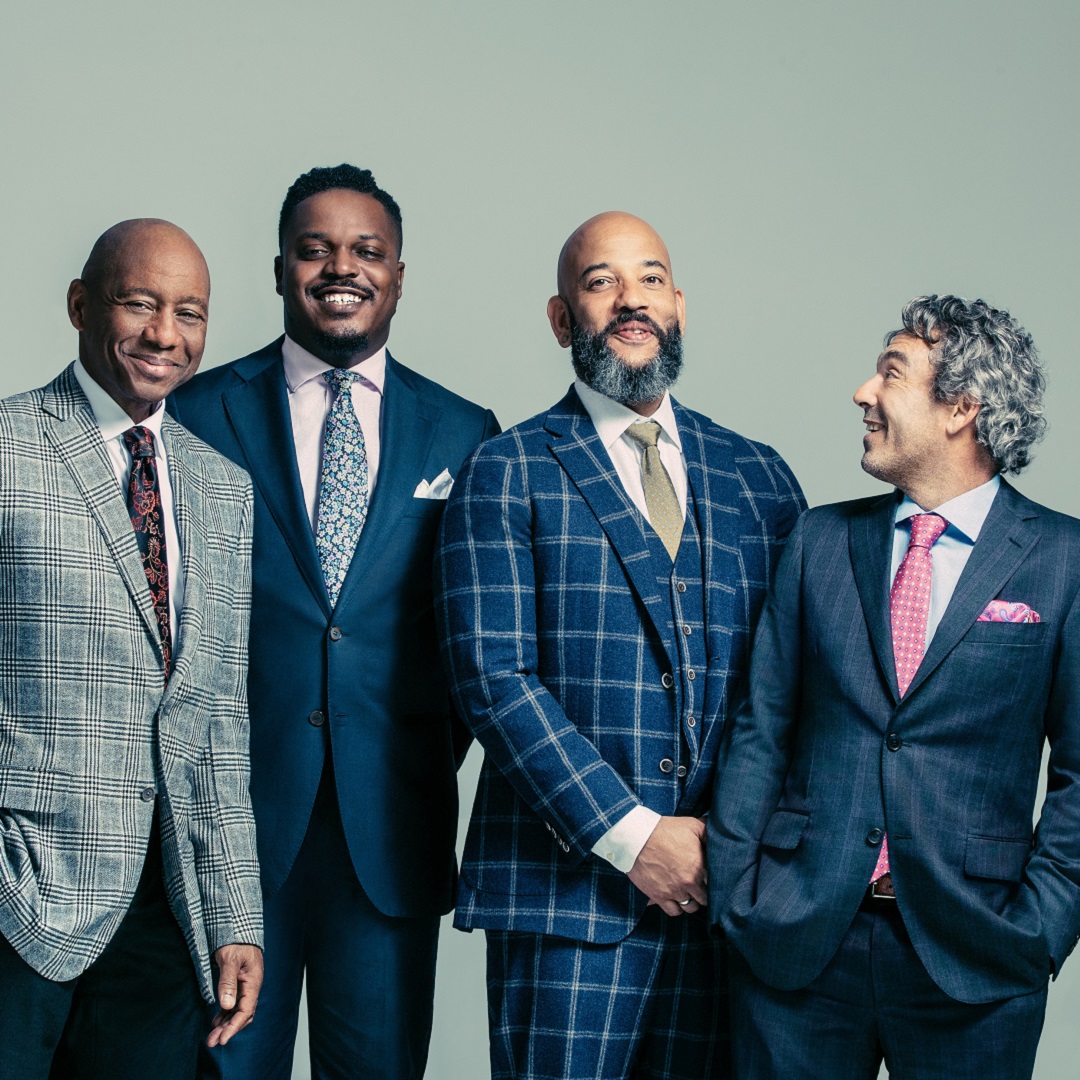 |
| Branford Marsalis Quartet |
Over the years, the Branford
Marsalis Quartet has put on some terrific concerts at the Paradise Jazz Series.
One example, is the 2017 concert with jazz vocalist Kurt Elling, featuring
music from the album “Upward Spiral.” The performance hit musically on every
conceivable level, and you left that concert feeling a spiritual awakening. Some of the music at the quartet's Friday night opening performance for the
2019-2020 Paradise Jazz Series was too way out. The quartet performed a few well-known
standards and cuts from their recent album “The Secret Between the Shadow and
the Soul,” starting the concert with the “Dance of the Evil Toys, ” one of several esoteric compositions from bassist Eric Revis. Marsalis joked while introducing one of Revis' tunes that it's the kind of music you play when you don't want to get paid. Many times the quartet switched from slower tempo numbers to the way out, making it seem as if you were experiencing two different concerts. On those way out numbers, pianist Joey Calderazzo, and drummer Justin
Faulkner whaled on their instruments like mad-men, which seemed to unnerve some
of the audience. The concert had two noteworthy moments. The quartet’s bluesy treatment of the oldie “Sunny
Side of the Street,” and the mini-reunion of Marsalis’s former bandmates Jeff
“Tain Watts,” Robert Hurst, and Terence Blanchard on a hip take of Thelonious
Monk’s “Rhythm-a-ning.”
Subscribe to:
Posts (Atom)