Sunday, April 26, 2015

A LOOK AT NEW ALBUMS BY HAROLD MABERN, ASHAKI ZEIGLER, JACKY TERRASSON & VINCENT HERRING

To call the jazz pianist Harold Mabern a legend is a gross understatement. Piano God would be a more fitting distinction. Mabern's musical history would take weeks to adequately breakdown. Worth touching on, however, is his affinity for accompanying vocalists. Chances are vocalists from all walks of life have Mabern on speed dial. At the center of his new album “Afro Blue,” are some of today’s top-tier jazz vocalists. Smoke Sessions Records made it available April 14th. Mabern invited to the studio jazz vocalists Gregory Porter, Kurt Elling, Norah Jones, Alexis Cole, and Jane Monheit. The result is a house party of sorts. Porter gets the party rolling on the title cut and “The Man from Hyde Park”. Elling is the life of the party, which isn’t surprising, he stands toe-to-toe with Mabern on “Billie’s Bounce”. Jones pour her voice all over Mabern’s piano on “Fools Rush In” and on “Don’t Misunderstand”.  
   
Detroit vocalists Ashaki Zeigler started hand stitching her career in the mid-90’s in the late jazz pianist Harold McKinney’s workshop The Detroit Artist and Jazz Performance Lab at the Serengeti Ballroom. Then she moved to the late pianist Teddy Harris’s jam session at Baker’s Keyboard Lounge. Often she was the only vocalist present. She held her own amidst a bunch of grandstanders. Over the years, Zeigler continued to grow artistically.Unfortunately Zeigler isn’t a household name yet as some of Detroit’s high echelon jazz female vocalists like Ursula Walker, Barbara Ware, and Audrey Northington. What Zeigler shares in common with those greats is class. Zeigler’s self-produced duet album “Remember The Way” shows she is comfortably proficient in jazz, R&B, smooth jazz, too. On top of that, she has the kind of voice you’d love to sing you to sleep every night. For proof, listen a few times to the title cut, which closes the album. The cuts likely to get the most water cooler talk are “Bye Bye Blackbird” and “Shakin’ It Off,” “The Nearest of You,” and Zeigler’s duet with bassist Ralphe Armstrong, the album’s co-producer.   
   
“Take This” is pianist Jacky Terrasson’s first album for Impulse Records. Terrasson made three dazzling trio albums for Blue Note Records. He is uninterested in making run-of-the-mill jazz albums it seems. “Take This” has the pianist diving deep into that freaking glorious imagination of his and returning to the surface with fresh takes on some jazz oldies like “Un Poco Loco,” “Blue In Green” and two extraordinary takes of “Take Five”.

  
Alto saxophonist Vincent Herring has a blow-the-roof-off-the-sucker mentality, which is in plain view on his new album “Night and Day” Smoke Sessions Records will release the gem May 12th. Herring covers some familiar ground, stretching out on “Fly, Little Bird, Fly,” “Wabash,” “There Is Something About You (I Don’t Know). These selections sound even grander with Herring support staff pianist Mike LeDonne, bassist Brandi Disterheft, drummer Joe Farnsworth, and trumpeter Jeremy Pelt.    

Thursday, April 23, 2015

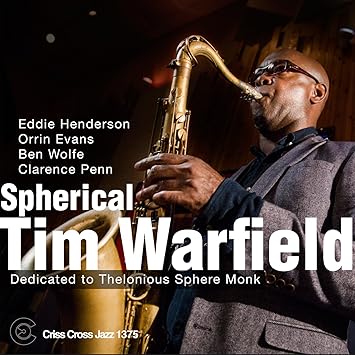
'SPHERICAL' TIM WARFIELD'S NEW RECORDING IS ALL ABOUT MONK

“Spherical” is saxophonist Tim Warfield’s eighth album for Criss Cross Records. The album is dedicated to the iconic pianist Thelonious Sphere Monk. Bassist Ben Wolfe, pianist Orrin Evans, drummer Clarence Penn, and trumpeter Eddie Henderson are Warfield’s kindred sidemen on the date, working out on some of Monk’s lesser-recorded material.

As a saxophonist, Warfield has substance, style, and chops galore. On top of that, Warfield has a gift for drawing brilliant feats of improvisation from his sidemen. Listen to how Warfield inspires the great trumpeter Eddie Henderson on “Off Minor Two”. Just last week, I Dig Jazz picked Warfield’s brain about “Spherical,”  his admiration for Henderson, and his loyalty to Criss Cross Records.

What inspired this Monk Tribute?

Pianist, Orrin Evans. This recording could not exist, without his conceptualized approach, which requires a "cubist" like methodology to blues and swing, to create idiosyncratic improvisations.

What impact did Monk’s music have on you?

I've been listening to Thelonious Monk's music since birth, as well as Miles Davis, Art Blakey, John Coltrane, Horace Silver and a plethora of other artists whose recordings were part of my parent's collection. My father loved Monk's music, but it was probably the least appealing to my ears, in early years. Back in the days when Monk was more of an enigma, I believe his music was much more of an acquired taste. It sounded wild to my young ears, and the dissonance was a bit agitating. I didn't find a deeper appreciation until around my early twenties when I began to study music in more depth.

Trumpeter Eddie Henderson is a standout on this album. What is your association with him, and what did he bring to the project musically and otherwise?

I've known Eddie Henderson for a few years now. The first time I heard him live was in 2001 in Copenhagen. I was performing at the Copenhagen Jazz Festival with Nicholas Payton. On our day off we went to go see Herbie Hancock's band perform music from his recording Gershwin's World." I was not only floored by Eddie's command of the instrument, but the huge core quality of "vocalism" he was able to execute through his horn. I actually contacted him in 2003, to play with a configuration of my sextet that featured Stefon Harris, Cyrus Chestnut, Vicente Archer and Rodney Green.

As far as the day of the recording, everyone, collectively speaking, came to play, as they always do. The music would have changed drastically with the removal of any one of the personalities. All their contributions were invaluable, but the seasoned maturity that Eddie brought to the session, to quote a common phrase used by Orrin Evan's, "was deep." He's an honest and selfless improviser, encompassing a thoughtfulness and daring all at the same time.

“Gallop’s Gallop”, and “Coming on the Hudson” are two of Monk’s lesser-known works. Why did you include them on the album?

Actually, I believe a good majority of the material chosen, were songs less frequently recorded. I researched the music with that intent. organist Shirley Scott once had a conversation with Terell Stafford and me, about all the great songs at our disposal, outside the obvious overplayed "oldie but goodies." I try to stand by that approach.

What was going through your head while you wailed on “Off Minor II”?

Listen and react appropriately. I know they are perceived as opposites, but I try my best to be both cognitively, yet viscerally connected to the music, hoping to play with a focus on what is required in the moment. 

You have made a bunch of albums for Criss Cross Records. Why have you stuck with the company for so long?

I actually have recorded 13 albums with Criss Cross with "Spherical," being my 8th date as a leader.

Criss Cross has allowed me to carve out a niche, without any artistic interference, not to mention the recordings have the absolute best sound quality in my opinion. Time permitting, I usually participate in every aspect of my recordings, allowing me the opportunity to freely conceptualize. It's, therefore, an easy relationship that I have with Gerry Teekens {the founder of Criss Cross}He allows me to be me, and I believe that's what folks expect me to be.


Saturday, March 21, 2015

WAYNE SHORTER'S QUARTET RETURNED TO THE PARADISE JAZZ SERIES

Brian Blade, Wayne Shorter, Danilo Perez, John Patitucci
Several things are apparent when you catch the Wayne Shorter Quartet live. One, the quartet never announces the title of tunes they play, nor in any way do they engage their audience. I’ve caught four of the quartet’s shows in recent years and neither member spoke more than a handful of words to the audience. OK, so Shorter is not a talker nor it seems is drummer Brian Blade, pianist Danilo Perez, and bassist John Patitucci.

One other thing worth noting is some of the music the quartet presents is rather heavily abstract, leaving you wondering if the quartet has a target demographic in mind when they composed their music.

Though the quartet has been together now approaching two decades and has made three excellent albums “Algeria,” “Beyond the Sound Barrier,” and “Without a Net,” the quartet isn’t a swing conscious group as other longstanding groups are, for example, the Branford Marsalis Quartet. Shorter’s music is heady and abstract.

The quartet presented much of that sort of music Friday evening at the Paradise Jazz Series at Detroit’s Orchestra Hall. The first half of the hour-plus set was heavy on abstract music the quartet specializes in. If you had a big meal prior to the concert, you could’ve dozed off during the first half of the show.

The quartet came off during that stretch as a tad self-indulgent. The music was wondrous in spots and melancholic in others. Each member virtuosity was on point. The quartet has a knack for giving the impression of creating precious works of arts on the bandstand right before your eyes.

At 81, Shorter still has an abundance of pep in his playing. He showed that during the second half of the set where the quartet deconstructed a Thelonious Monk number and the quartet surprised the audience by horsing around with a handful of Shorter’s classics.

Shorter let the fellows open up and have a little fun in the second half, particularly Blade, the most animated member of the quartet. Shorter still has one of the greatest minds in jazz. He doesn’t squander notes or grandstand. The quartet is tighter than banjo strings. Surely, some members of the near capacity crowd were disappointed because the quartet didn’t play music from its albums.

You can never bank on anything remotely conventional from the quartet. The Shorter fans and supporters in attendance understand his nature and musical idiosyncrasies and they seem to relish in them.

Monday, March 16, 2015

FEMALE JAZZ ENSEMBLE PUT ON A FLAWLESS SHOW AT KERRYTOWN CONCERT HOUSE

Pianist Ellen Rowe
It is a crying shame the female jazz ensemble that performed Sunday afternoon at Kerrytown Concert House in Ann Arbor, MI is only available to the public once per year during Women in Jazz History Month. An ensemble this engaging and terrific should be accessible weekly at some club or concert hall regionally. 

The ensemble was comprised of drummer Nicole Patrick, trumpeter Ingrid Racine, saxophonist Rachel Mazer, trombonist Melissa Gardiner, vocalist Lauren Scales, bassist Marion Hayden, and pianist Ellen Rowe.

They were at the concert house paying tribute to some of the great women jazz musicians of all times. The ensemble put on a meticulous show. The members had a chance to strut not only their considerable chops but also their arranging abilities and compositional skills. The ensemble's set list was a mix of classics and originals.

The women touched on every nook and crevice of jazz the blues, bop, swing, and ballads. In the hour plus set, there’re too many highlights to list, but the one that stuck to my ribs was trombonist Melissa Gardiner wailing on a Melba Liston number. Obviously, from the passion Gardiner displayed during the solo Liston was one of her primary musical influences.

The ensemble performed two of Liston’s tunes, along with material from Alice Coltrane arranged by Marion Hayden and “Lady Sings the Blues” lyrics by Billie Holiday sang perfectly by Lauren Scales. Keep an eye on Scales. She's going to be a force in the music in the coming years. Mark my word.

Tenor saxophonist Rachel Mazer was another standout. She has a big polished tone on the tenor and she wolfed down the changes like Valentine chocolates when she soloed.

The ensemble's sound and overall appeal is powered by Ellen Rowe who have some of the sweetest fingers ever to caress piano keys. Besides, Rowe is everything you want in a bandleader, non-intrusive, supportive, and firm-handed when necessary.

The ensemble played a blues, and Rowe’s solo was so good and convincing it could’ve made the Jesus cuss. This is a world-class ensemble of female jazz swingers – but who really cares about the ensemble’s gender – who I’d pay good money to experience any day of the week.

Unfortunately, there’re no club owners forward thinking enough to give this ensemble a shot. Except, of course, the progressive folks at Kerrytown Concert House.

Monday, February 16, 2015

JAZZ AT LINCOLN CENTER ORCHESRTA PERFORMED THE MUSIC OF MINGUS, DIZZY, ELLINGTON, COLTRANE & BRUBECK AT THE UMS JAZZ SERIES CONCERT

Jazz at Lincoln Center Orchestra
Of the fifteen members of the Jazz at Lincoln Center Orchestra, nine pitch in regularly with arranging music the orchestra plays. Thus giving it the ability to put together a show in a week. When you get to hear the meticulously arranged compositions like the ones the orchestra played Sunday afternoon at their annual concert for the University Musical Society’s jazz series at Hill Auditorium, you’d believe the members responsible for the arrangements spent way more than a week perfecting the arrangements.

The one hour and forty-five minute concert the orchestra put on Sunday was the best in recent years. The orchestra, under the direction of trumpeter Wynton Marsalis, featured some of the works of Charles Mingus, Dizzy Gillespie, Duke Ellington, John Coltrane and Dave Brubeck. 

The orchestra didn't play a group of Mingus numbers, for example, followed by a batch of Ellington numbers. Instead, the compositions were interspersed, which gave the overall presentation a freer structure.

The orchestra opened with “Dizzy Moods,” composed by Mingus as an nod to Gillespie. Then the orchestra moved into Ellington’s “Oclupaca” a movement from his “Latin American Suite” and Gillespie’s “Fiesta Mojo,” a samba the orchestra added a lot of swing to.

The concert switched into a thoughtful and somber state when the orchestra played Marsalis' arrangement of Coltrane’s “Alabama”. The touching  featured solo by saxophonist Paul Nedzela could have caused a convict to weep. The orchestra showed they’re more than bloodthirsty swingers.

They ventured way out their swing comfort zone on Mingus’ “Los Mariachis (The Street Musicians)”. This number had more changes than a fashion show. The orchestra played each seamlessly. 

The standout soloists here were bassist Carlos Henriquez and drummer Ali Jackson who had the woman seated to my left all worked up as if she was viewing Internet porn. Jackson had his Mojo working big time.

This was a wonderful concert to sit through. Each musician was in mint form. It was good to hear a female trumpeter, Tanya Darby, cutting up in the trumpet section.

Marsalis has taken a lot of heat over the years for the absence of female musicians in the orchestra. Darby wasn’t featured on any of the selections, but she fit in nicely in the trumpet section with Marcus Printup, Kenny Rampton and Marsalis.

One of the delights was listening to Marsalis explain the origins of each composition. Marsalis is a walking encyclopedia of jazz, and listening to him is like being in a graduate seminar on the music. 

Wednesday, February 11, 2015

ALTO SAXOPHONIST RUDRESH MAHANTHAPPA BREAKS DOWN HIS NEW ALBUM 'BIRD CALLS'

Rudresh Mahanthappa
You could spend damn near a year listing all the jazz alto saxophonists who owe a debt to bebop icon Charlie Parker. The alto saxophonist Rudresh Mahanthappa is quick to acknowledge Parker was one of his main musical influences. 

To this very day, Parker influence remains a big part of Mahanthappa's playing. He has a new album that was released nationwide Tuesday. He titled the album “Bird Calls” and it is a tribute to the late bebop icon. Mahanthappa opted not to put his spin on some of Parker’s well-known bop classics. 

Instead, he infused new compositions with snippets of Parker’s works, and then he assembled an excellent group to execute the new material. The result is a Charlie Parker tribute album unlike any other. 

I Dig Jazz emailed a batch of questions to Mahanthappa about the making of “Bird Calls” and the impact Parker has had on him as a player. Here’s how Mahanthappa broke it down.

How has Charlie Parker influenced you?

It’s hard to sum up in a few sentences.  His innovative spirit and joyful presentation are the most influential traits.  He was obviously a genius but the ways in which I am affected by his work go beyond the music and transcend more towards a template for overall communication and expression as an artist and as a human being.

Can you recall your first exposure to Parker's music?


Of course, it was an album called "Archetypes" that my first saxophone teacher had loaned me.

Has Parker always been your chief influence? If not, where does he rank among your musical influences?

I don’t think it behooves anyone to rank ones influences.  The palette of impactful moments and experiences is so wide ranging.  He’s a very strong influence and maybe more importantly, an early one as I first heard his work when I was very young. Those artists who first inspire one to play or practice are so significant. 

What inspired "Bird Calls"?

The concept behind Bird Calls was an idea that had been marinating in my brain for several years.  I had always considered that further dissection of Parker’s work could yield fresh and intriguing compositional ideas beyond the normal extraction of “licks” that have become be-bop cliches.  "Donna Lee" was the most blatant example to me of a piece that contains a plethora of modern material that defies genre and style.

How long did the album take to make, and were there any obstacles you had to overcome?

The music was constructed in several phases over 1½ years as I had other projects going simultaneously and did not yet know that I would be recording this Bird experiment. The process started with writing a few tunes for a concert at Tribeca Performing Arts Center’s Lost Jazz Shrines series where I had been asked to put together a program that somehow paid homage to Charlie Parker. 

A few months later, I presented this project again with a few more tunes at The Stone in NYC. The band debuted in its full formation with the album set of material at the Newport Jazz Festival this past year and we recorded a few days later.  The main obstacle concerned finding myriad modes and strategies to convey Parker’s musical wizardry while maintaining my own voice as a composer.

Why did you decide to compose new music instead of playing some of Parker's signature works?

I don’t believe playing Parker’s music adequately pays tribute to the gifts that he bequeathed to us.  It’s much more important to show his lasting impact on the shape of modern music.  That is something that goes well beyond the scope of performing his compositions.

How challenging was it working chunks of Parker's music into your original compositions?

Working in “chunks of Parker's music” is an over simplification. Each of my compositions for this album has a unique strategy in how Parker’s music is utilized. Sometimes it’s rhythmic content of something he played, other times it might be a snippet of a melody that has been re-contextualized.  Each piece is tied to a particular Bird tune or solo but that tie varies greatly from piece to piece. So keeping that in mind, it was very challenging to keep my approach fresh through out the album.

Do you see yourself someday making an album of Parker's compositions?

No. That does not interest me at all.

You have a world-class group in trumpeter Adam O'Farrill, pianist Matt Mitchell, bassist Francois Moutin, and drummer Rudy Royston. Adam O'Farrill's playing throughout the album was exceptional. How important was he to the project?

It was important to me to have a trumpet player on the album, as I wanted to maintain that front line sound of Bird and Diz (or Miles, Herb Pomeroy, etc).  I had been hearing about Adam for a while so I did some YouTube research and was blown away. Beyond being a forward-thinking prodigy, Adam is a wonderful human being and perfect fit for the band. I hope that we will play together for years to come.

if you had the chance to meet Parker, what would you have said to him?

I would say “thank you” and probably give him a kiss and long hug.

Saturday, January 31, 2015

KENNY GARRETT MOSTLY STUCK TO HIS RECENT MUSIC AT THE PARADISE JAZZ SERIES CONCERT

Kenny Garrett
If you caught the Kenny Garrett set Friday night at Orchestra Hall, the third of the Paradise Jazz Series, and expected him to swing through music from his past albums such as “Songbook,” “Simply Said,” and “Pursuance: Music of John Coltrane,” chances are you were a bit disappointed when he didn’t.

There’s plenty of swinging that happened on the stage anyway but Garrett stuck to his most recent music. Garrett didn’t present any of the old stuff that put him on the map as a bandleader many moons ago. That doesn’t suggest in any way Garrett put on a bad concert. Garrett still plays the alto like a frustrated tenor sax player.

Garrett remains the reigning king of the alto sax. He has for many years although there’s some stiff competition out there with the likes of Rudresh Mahanthappa and Miguel Zenon, It was the band’s first gig of the New Year. There weren’t any visible signs of rust. That’s a sign of the level of musicianship in this band.

Some of the music Garrett’s band played had chanting, which was a disruption at times. You couldn’t tell who was doing the chanting. Garrett’s sweetness manifested when he gave the up-tempo burners a rest and played a ballad at grown folk’s tempo. 

Garrett was unsurprisingly brilliant mostly, and he has an outstanding band in drummer McClenty Hunter, bassist Corcoran Holt, percussionist Ruby Bird and pianist Vernell Brown.

Brown was the standout throughout hitting big with a series of highly charged solos. It seemed as if his fingers had knocked back a case of energy drinks before the set began. 

Garrett fancies percussive and showy pianists in his band. Over the years, Garrett has had some fine ones in Carlos McKinney and Benito Gonzalez. Brown has been with Garrett the longest. Brown sounded like McCoy Tyner at the height of Tyner’s power.

Brown didn’t carry the show though. Holt and Hunter pitched in, too. Hunter participated in the concert’s best spot with the meaty exchange with Garrett on the fourth number, which came off as a battle of wills. 

Holt was absolutely brilliant. He played a lively bass solo that had the hairs on the necks of the audience doing the Dougie.

Bird, on the other hand, seemed out of sorts. Throughout the set, he was in his own world. He’s a decent enough percussionist but he didn’t put forth anything memorable. His dancing at the end of the set was silly and unnecessary.

Garrett showed he can be a ham also doing everything in his power to get the audience to cheer louder when he played his signature set closer “Happy People”. It was cheesy and overkill because Garrett had the crowd eating out of his hands all night long.