Tuesday, October 21, 2014

MERI SLAVEN & GARY SCHUNK HAVE STELLAR NEW ALBUMS

It’s a crying shame that a jazz vocalist who sings as divinely as Meri Slaven isn’t a household name. Sure, in Michigan, her home state, she's popular and she’s performs regularly at upscale clubs and restaurants. She’s also a key member of a hot vocal group the Metro Jazz Voices. Maybe the recent release of her new album “Get Out Of Town,” will get her the national attention she’s earned and she deserves. “Get Out Of Town” has 13 songs and she staffed the album with some top Detroit jazz musicians such as Ron English, Sean Dobbins, Paul Keller, and Scott Gwinnell. Hard to make less than a stellar album with such star power. Slaven pours her voice over well-known oldies such as “The Trouble with Me is You,” “Moonlight” and “Like a Lover”. The cuts likely to get played over and over are “A Blossom Fell,” “I Thought About You” and “True Colors” because you get to experience Slaven one on one with Gwinnell and Keller. Her voice could turn the devil into a romantic.


Gary Schunk has been an in demand jazz pianist for decades. Early this year, the Detroit jazz community almost lost him. He was in a near fatal car accident. Fortunately, he’s bounced back and is back on the scene swinging harder than ever. There’s a lot of work yet to do. First order of business is he has to push his new album “Kayak,” one of the finest jazz trio recordings made in Detroit in a while. Pure down to the bone jazz, akin to the classic trio dates great jazz pianist such as Red Garland and Tommy Flanagan used to make. “Kayak” is the sixth album on the Detroit Music Factory. Schunk is at the top of his game, which isn’t surprising. There’s never been a time when he wasn’t. As some of his peers have noted over the years he's gifted and he can play everything R&B, classical, bop, Latin, and swing. Fronting a trio, as the album clearly proves, is his true calling. There are 12 cuts on “Kayak” that Schunk, drummer Peter Erskine, and bassist Ray Parker approach with the adherence to craftsmanship of master tailors.

Saturday, October 18, 2014

DIANNE REEVES' PARADISE JAZZ SERIES CONCERT WAS HEAVY ON SCATTING, STORY TELLING, LIGHT ON SINGING

Dianne Reeves

The jazz vocalist Dianne Reeves’ concerts are hit or miss. When she’s on point, her concerts are something to behold. When she has an off night, you feel letdown as if she didn’t give her all. She has one of the best voices in jazz, and her scatting rivals any of the great jazz vocalists of any era. Friday night at Orchestra Hall in Detroit, Reeves played the first concert of the 2014-2015 Paradise Jazz Series.

Reeves scatted a hell of a lot, which is often heavenly when she does so in moderation. She’s a natural born storyteller. The thing is the stories haven’t changed over the years. You wish she’d update them, or better yet spend more time singing.

During the second set Friday, for example, Reeves was chatty, particularly when gushing about actor George Clooney who hired her for the movie “Good Night, and Good Luck,” and talking about her aunt fooling a group of vegetarians at a family cookout by lacing their vegetables with bacon grease.

The first set smoked thanks to Reeves’ band – pianist Gerald Clayton, bassist James Genus, guitarist Romero Lubambo, and drummer Terreon Gully – The band is tighter than pricey dress shoes, and they supported her like four big brothers.

Clayton is the new member. It was his second show with the band. He’s a young buck and he’s made quite a name for himself. As a session leader, he’s released three excellent albums, and he showed his knack for backing a world-class jazz vocalists throughout the concert.

The band warmed the stage for Reeves, opening with the standard “Summertime”. Then she floated on stage, scatted her way through the second song, which didn’t have words. At the end of it, she tacked on an amusing story about attending a Stella Cruz concert in L.A. back in the day. Reeves likes to include amusing stories in the middle or at the end of songs.

Reeves is a wiz at improvising. She does it as skillfully as a horn player. That was on full display when trumpeter Terence Blanchard joined the band for a seductive take of “Stormy Weather”.  

Note for note, she matched Blanchard. At one point, it seemed as if they were making love musically on stage. The concert could’ve ended after that number with the audience satisfied she’d given them a good show.

But the concert carried on. And Reeves sang less and talked more. The audience didn’t mind though. However, when you pay to hear a top jazz vocalist, you want the vocalist to at least sing for 90% of the concert.  

Thursday, October 16, 2014

GREGORY PORTER OPENED THE 2014-2015 UMS JAZZ SERIES WITH A NEAR FLAWLESS CONCERT

Gregory Porter
No doubt, Gregory Porter is the top male vocalist in jazz right now. His 2012 album “Be Good” put him on the map, and his follow up “Liquid Spirit” earned him a Grammy. He caught many jazz fans off-guard when he hit the scene about five years ago. Jazz has male vocalists of all makes and models, but none as dynamic or as grassroots as Porter.

Wednesday evening at the Michigan Theater in Ann Arbor, Porter opened the University Musical Society 2014-2015 jazz series with a near flawless two-hour set. Porter and his band – saxophonist Yosuke Sato, pianist Chip Crawford, bassist Jahmal Nichols, and drummer Emanuel Harrold – performed cuts from Porter’s albums “Water,” “Be Good” and “Liquid Spirit”. The two-hour set was heavy on music from the latter album.

Porter’s band came out first. Right off, they got chummy with the melody of “Painted On Canvass,” one of the best cuts from “Be Good”. Then Porter walked out. He was only a handful of choruses into the song before the crowd lost their ever-loving minds. He’s a vocalist capable of singing R&B, blues, and jazz with equal aplomb.

Porter has a lot of stagecraft. All concert long, he had the crowd geeked, and yelling the title of songs they wanted him to sing. At times, he had the swagger of a country preacher, especially when he belted “No Dying Here” and “Be Good”. Porter is big on crowd participation also. Often during the set, the crowd was working and singing harder than Porter.

The night’s most endearing moment was Porter’s duet with pianist Chip Crawford on “Imitation of Life”.  Porter’s voice melted over the lyrics. His band is capable for the most part, and he allowed them more leeway than any band backing vocalists should get.

Saxophonist Yosuke Sato was all over the map. He has the stage presents of a smooth jazz saxophonist, heavy on long soloing and grandstanding. Yes, he sounded good, but there wasn’t much meaning to his solos.  He seemed to recycle the same note during one long solo after the other.

At first, his solos were engaging and they got the crowd psyched. But roughly four songs into the set the long soloing became annoying. Crawford was guilty of the same sin. To Sato's and Crawford's credit, the audience was engrossed. 

Sato and Crawford were definitely showboating. It appeared as if they were competing with Porter. Porter encouraged the behavior. So not only is Porter a freakishly awesome vocalist he's also a generous  and a liberal bandleader. 

Monday, September 22, 2014

THE JAMES CARTER ORGAN TRIO FIRST GIG IN DETROIT IN NINE YEARS WAS PHENOMENAL

Leonard King Jr., James Carter, and Gerard Gibbs
The jazz saxophonist James Carter formed his organ trio in Detroit soon after he made the album “Live at Baker’s Keyboard Lounge” in the summer of 2001. Since then the trio, which includes drummer Leonard King Jr. and organist Gerard Gibbs, has become a household sensation. The trio has toured the world and has put out three albums. The most recent one is the blues inspired “At the Crossroads”.  

The trio has one apparent flaw, failing to hit Detroit regularly. Sunday afternoon, for the first time in nine years the trio played in Detroit at the First Unitarian Universalist Church. During the three-hour plus concert, Carter never let on why the trio has put off play in Detroit.

Carter, Gibbs and King Jr. put on a phenomenal concert. Chances are no one cared why they haven’t made time to hit Detroit. Of late, the trio has toured overseas, playing the music of the great gypsy jazz giant Django Reinhardt. Carter called the tour “Django Unchained”. 

Sunday, the trio performed some tunes from "Django Unchained". Carter was all over the saxophone, making it do things that defied logic. On the opening number, Carter violated several commandments and blew so forcefully on one tune it could’ve blown Jesus off his cross. One of Carter’s trademarks is playing cadenzas. Throughout the concert, he played many memorable ones. 

There were moments when Carter blew so recklessly it appear the saxophone was going to explode in his hands. Throughout the trio played as if making up for lost time. Apparently, Carter, King Jr. and Gibbs absolutely love playing with each other.The trio played an enough music the first set to satisfy the audience. The second set was more of a bonus. 

The trio tore through cuts from “At the Crossroads” such as “Walking The Dog,” “Lettuce Toss Yo’ Salad,” and “The Hard Blues”. Of course, the audience came for Carter, but Gerard Gibbs was a scene-stealer and King Jr. had his moments of brilliance. Gibbs had the church organ preaching.

Gibbs is the soul of the trio, and the feats Carter created on the saxophones Gibbs matched on the organ. Highlights of the concert were witnessing the exchanges between Carter and Gibbs. He plays the keyboard in a number of bands and he plays piano in Carter’s quintet. He's a decent enough pianist but the organ is his natural habitat. He’s one of the top jazz organist around presently.

King Jr., the trio's elder statesman, drummed so ferociously he destroyed a pair of drumsticks. His singing was a nice contrast to all the hell the trio raised. Wonder why Carter didn’t feature him on more tunes. Not surprising, the response to the concert was overwhelmingly positive. Maybe the trio won’t wait another nine years to hit Detroit again. 

Sunday, August 31, 2014

FOUR NOTEWORTHY SETS FROM THE FIRST FULL DAY OF CONCERTS AT THE DETROIT JAZZ FEST

Cyrus Chestnut
Saturday, marked the first full day of concerts at the 35th Detroit Jazz Festival. Although I got an early start, I didn’t catch all the concerts I planned to. I started the day at the Absopure Pyramid Stage. I caught Hallady/Schunk Latin Experience set. The group of Detroiters played from Doug Halladay’s latest album “Celebrando!”.

I bumped into Halladay’s wife opening night of the festival. She implored me to check out the set, promising it would be smoking. She was right although there was some overkill. The soloing was too long. I wondered if the first two numbers would ever end. Hallady is a fine composer and he put together a solid group of Detroiters to play his music. If this band stays together, it will be one of the best in Michigan.

After Hallady’s set, I shot over to catch alto saxophonist Phil Woods’ set at the JP Morgan Chase Main Stage. Woods is one of a handful of remaining players from the bop era, and although he had to me wheeled onto the stage and he carries an oxygen tank to help him breathe, he still sounds wonderful. His chops hasn’t aged one bit.

His band trumpeter Brian Lynch, pianist Bill Mays, bassist Steve Gilmore and drummer Bill Goodwin sprinted through a number of goodies from the American Songbook. Woods had to take a break after a couple of meaty solos. Emphysema has slowed him down some. Woods made light of his medical condition, joking that when a saxophonist is hit with emphysema it’s a sure sign he plays too many notes.

I stayed at the Chase Stage. Pianist Cyrus Chestnut followed Woods. Chestnut had a young band with him who looked like high school music students, but they swung like veteran players. Chestnut set was a tribute to the late great jazz pianist Dave Brubeck. 

Chestnut did an excellent job remaking many of Brubeck’s signature tunes. The crowd had a collective orgasm when Chestnut broke into the hippest take of “Take Five” I ever heard, a classic written by Brubeck’s band-mate Paul Desmond.

Before the set started, Chestnut warned the crowd he did not intend to play Brubeck’s music as originally written. It was Chestnut's first stop at the Detroit Jazz Festival since 1992. 

Saxophonist Pharoah Sanders was the musician I wanted to see the most. I wondered if Sanders was still deep into his free-jazz bag. Sanders played a straight-ahead set with little of the antics on the sax he’s known for. 

Sanders didn’t announce the tunes his band played. The crowd was so wrapped up into the performance they really didn’t give a damn. Sanders gave them what they wanted undiluted jazz and brilliant soloing from his staff drummer Joe Farnsworth, pianist Will Henderson and bassist Nat Reeves.  So far, my favorite set of the festival

Saturday, August 30, 2014

THE 35TH DETROIT JAZZ FESTIVAL OPENED FRIDAY EVENING WITH A TERRIFIC SET FROM BAD PLUS FEATURING JOSHUA REDMAN

Bad Plus & Joshua Redman
After 25 minutes of backslapping by the big sponsors of the Detroit Jazz Festival, the 35th installment of the nation’s largest free music festival opened with a brilliant set from the jazz trio Bad Plus. Drummer David King, bassist Reid Anderson and pianist Ethan Iverson make up the trio, and their special guest was saxophonist Joshua Redman, the DJF’s artist-in-residence. Honestly, the Bad Plus’s set would’ve been badass without Redman, but his being there was a bonus.

The Bad Plus is a tough band to label. One minute they played what appeared to be rock fusion. The next they stretched out on a free-jazz piece. Then they slipped in a ballad played so lovingly it would've made a stingy bastard donate his life-savings to charity.

Bad Plus kept changing the game plan, playing a bunch of multi-layered original compositions the conservative DJF crowd ate up. Redman was terrific throughout. You could follow the logic of his playing whether he played mellowly as he did on the set opener “Love is the Answer,” or played wildly as he did on the set closer. Anderson wasn't being cocky when he said the band's performance set the tone of the festival.

The second set was billed A Night at the Apollo starring Ted Louis, Margot B, Kevin Mahogany, the Wonder Twins and David Berger’s NYC Big Band. It was a big project design for the DJF. On paper, the project seemed easy to pull off. But the result was a cluster fuck.

Berger’s Big Band was on point playing swing, bebop, and the blues with heart, energy and efficiency. The other acts were flat. Ted Louis is a competent tap dancer and singer. But his impression of Sammy Davis Jr. and Cab Calloway were lame. The Wonder Twins dance routine was puzzling. Kevin Mahogany is a great jazz singer, one of the best in jazz. But his booming voice couldn’t rescue the set.

Mahogany did get a brief rise from the crowd when he belted a blues, his best punch. If Berger’s big band had played the set alone, it would’ve been good enough to maintain the spirited tone Bad Plus had established. 

Sunday, August 24, 2014

UPCOMING TALK WITH RANDY WESTON & BILLY HARPER AT THE DETROIT JAZZ FESTIVAL

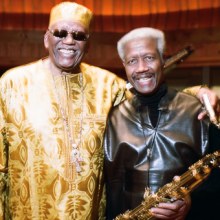
Randy Weston and Billy Harper
July was a good month. I received a bunch of excellent jazz albums, and I picked up writing drive-by album reviews. The kind of reviews that come in under 100 words. A former music editor at the Metrotimes--a weekly newspaper in Detroit where I covered jazz for 17 years--coined the name years ago. I continued using it because it fits the short reviews I enjoy writing. 

Anyway, I spent the better part of July listening to new music. Saxophonist Sonny Rollins' and pianist Cyrus Chestnut's albums were the best followed by bassist Rodney Whitaker and pianists Eric Reed and Orrin Evans.

In August, things have slowed down, which is OK. The Detroit Jazz Festival is around the corner. My friend jazz historian Jim Gallert asked me to interview pianist Randy Weston and saxophonist Billy Harper at the Jazz Talk Tent.

At first, I turned Jim down because I’m uncomfortable talking to crowds. I’ve interviewed many jazz musicians mostly one on one or via telephone. Jim is a salesman at heart, and he convinced me I’m the right man to conduct the interview. 

The past three weeks, I’ve been researching Weston and Harper. I’ve talked to jazz legends before. In fact, I’m an old pro at it, having picked the brains of Wayne Shorter, Sonny Rollins, Horace Silver, Richard Davis and many others.

I bought Weston’s autobiography “African Rhythms”. It’s taken me a week to get through it. Weston led an upstanding life and that doesn’t make for riveting reading as Hampton Hawes’, Miles Davis’ and Art Pepper’s autobiographies was. They led troubled lives.

Anyway, I got some useful information from Weston’s book, particularly his musical partnership with trombonist Melba Liston which Weston likened to Duke Ellington and Billy Strayhorn's partnership.

I couldn’t find a lot of information about Harper. I checked All Music, All About Jazz, Harper’s official website and a few more online sources. All had the same basic biographical stuff so I won’t have a ton of questions for him. 

Weston and Harper put out a wonderful album in 2013 titled “Roots of the Blues”. I plan to make it the thrust of the interview. I want to know about their musical friendship and how it’s grown over the years. They’ve been collaborating for decades. I’ll warm up with that. Then I’ll question them about memorable chunks of their musical history. That should eat up most of the 45 minutes I have to interview them.