Saturday, November 6, 2010

LADY DEE DEE

Jazz vocalist Dee Dee Bridgewater
If Eleanora Fagan (Billie Holliday’s birth name) were alive, Dee Dee, I would write her a letter expressing what a spectacular concert you put on Friday evening at Orchestra Hall in Detroit, MI. Dee Dee the letter would say the following:

Dear Mrs. Fagan,
You don’t know me from Adam. I am Charles L. Latimer, a jazz journalist from Detroit Michigan. On November 5th, I attended jazz vocalist Dee Dee Bridgewater’s Billie Holliday tribute concert at Orchestra Hall. I’m sure by now you’re familiar with Dee Dee. In my book, she’s one of the top jazz vocalists in the game, and Friday night she put on a marvelous show, performing songs that you immortalized. Bridgewater has stagecraft, and she knows how to engage an audience.

Her set Friday night was successful because Bridgewater didn’t try to emulate your style. Listening to Bridgewater workout on “Fine and Mellow”, “Strange Fruit”, and “God Bless the Child”, I wondered if she conversed with your spirit in the dressing room before the show began. Mrs. Fagan, it felt as if your spirit gave the vocalist a pep talk. If such a conversation transpired Bridgewater carried out your advice to the letter. Let me recap some of the highlights.

Bridgewater had an excellent band that she’s totally in love with saxophonist Craig Handy, pianist Edsel Gomez, bassist Kenny Davis, and drummer Greg Hutchinson. Bridgewater is no spotlight hog. She shared the glamour with her band-mates, and she engaged in an improvisational exchange with each. On “Fine and Mellow”, she traded measures with Handy-who she affectionately referred to as the Handyman. They shared a kinetic connection all night long.

Two songs later, she called out Hutchinson. Mrs. Fagan, it was the first time I witnessed an improvisational exchange between a drummer and a vocalist. Bridgewater and Hutchinson traded notes like stockbrokers. Near the end of the concert, Bridgewater and Davis had a duet.

Davis is a sensational jazz bassist. They played a song you wrote in the 30’s “My Mother’s Son-In-Law”. At the end of the composition, she worked in a few choruses of “Hit the Road Jack”. The audience went bananas. The sure-footed pianist Gomez arranged all the material her band played, and he stretched out on several up-tempo selections, but overall he was more of a behind-the-scene-guy.

As for Bridgewater, she’s a very sensual vocalist. Mrs. Fagan forgive me if I sound perverted. Bridgewater seemed to make love with every note she sang. She prefaced songs with plenty of sexual innuendo. Honestly, it became tiresome at times, but that's the only bad thing I can say about an otherwise great performance. She knows how to captivate an audience.
Sincerely,
Charles L. Latimer

So Dee Dee, if Lady Day were still alive this is the letter I’d spend her. You really honored Holliday in grand fashion. I bet she would appreciate that you did so without emulating her style.

Friday, November 5, 2010

BLOWING LIKE MILES

Trumpeter Eddie Henderson
Be bop, Cory the barber’s 12-year-old daughter stormed pass KB's work station carrying her book bag. She slammed and locked the restroom door. A minute or so later, Cory walked into the shop. Cory wore a Levi denim jacket, a Detroit Tiger’s baseball cap turned backward, and a new pair of Timberland work boots. He hung the jacket on the coat rack next to the shoeshine booth. Cory knocked on the restroom door. He told Be bop she could forget going record shopping at Melodies and Memories Saturday. Cory was hot. He ignored me and KB who was trimming up my hair. Whenever Cory is upset, he cools down by playing Miles Davis’ “Kind of Blue”. He couldn’t find it, so instead he played “For All We Know”, the new album by trumpeter Eddie Henderson. When I arrived at 100% Barbershop for my bi-weekly cut, KB was the only barber there. Cory usually opens the shop. KB explained Cory received a call from Be bop’s school. Mrs. Cotton, the school’s principal, suspended Be bop because she got in an altercation with a fellow student. Be bop threaten to beat up a classmate because the classmate said James Carter, Be bop’s favorite jazz musician, was overrated. Cory believes Be bop inherited her bad temper from her mom.

Eddie Henderson version of Fats Waller’s “Jitterbug Waltz played throughout the shop. Cory flopped down in the shoeshine booth chair.
“That girl is becoming more and more like her mother everyday. Those kids at that school are too smart for their own good. Be bop got into an argument about James Carter.”
“She loves James as much as she loves you," I said.
“You got that right”.
“Is thatMiles Davis”?
“No. That’s Eddie Henderson”.
“He still sounds like Miles”.
“Miles influenced him.”
“You would think as long as Eddie has been on the scene he’d have his own voice by now.”
“He’s carrying on a tradition of lyrical trumpeting. In my book, there’s nothing wrong with sounding like Miles,” Cory said.
“That’s a hip arrangement of ‘Jitterbug Waltz.”
“Do you think it’s better than Eric Dolphy’s version on Music Matador?
“The arrangement is hipper. Eddie’s opening passage is deceptive.”
“How so”?
“He makes it seem like he’s going to play a ballad,” I said.
“I thought the same thing when I first heard it.
Like Miles Davis, Eddie treats every note like precious pieces of art.”
“He puts a lot of distance between notes, too.”
“Yeah, he gives John Scofield and Doug Weiss plenty space to do their thing improvisationally speaking. I like the fact that Eddie left the piano player at home, and replaced him with a guitarist.”
“You can’t go wrong with Scofield.”
KB saw Be bop slide a sheet of paper under the restroom door. He turned off his clippers, walked over to the restroom and picked up the note. Then he read it, giggled, and he gave it to Cory. He read the note aloud.

“Mr. Stubblefield, you are hypocritical. It isn’t fair that you put me on punishment for standing up for my favorite jazz musician. I know I could have handled the situation with Raquel a little better. But I hate her. She is so stupid and fake. I knew you’re embarrassed when principal Cotton told you about the argument I had with that ugly cow. I guess you are right. I inherited mama’s bad temper. Dad I have witnessed you lose your cool on many occasions. What about the time when you loan Uncle Billy the “Booker Ervin and Brass” album and he returned it all scratched up. You called him every bad name under the sun and refused to speak to him for months although he’s your only brother. You behaved just as foolishly and as childishly as I did today, but you didn’t see fit to punish yourself like you punished me for giving Raquel a piece of my mind. In fact, the next day, you went to hear Kurt Elling at the Music Hall. Daddy, will you please reconsider by punishment. I haven’t been to Melodies and Memories in a long time. I was looking forward to hanging out with you Saturday. I‘m sorry that I threaten to beat up Raquel. Honestly, it’s partly your fault because you turned me on to James Carter’s music in the first place. If necessary I will-although reluctantly-apologize to Principal Cotton and horse face Raquel.
Sincerely,
your loving daughter who has been a straight A student since pre-school

After Cory read Be bop’s note, KB and I laughed. Whenever Be bop is mad at her dad she refers to him as Mr. Stubblefield.
“Be bop is a piece of work,” KB says turning on the clippers.
I heard the restroom door click. Be bop emerged. It was obvious she had been brooding. Her eyes were red. She finally spoke to me and KB, and she hugged her dad. Cory had cooled down. She told her dad she was hungry. He fished some money out his pocket. He told her to go next door to Jet’s Pizza. She asked if we wanted anything.
“As a rule, I hate when there’s no piano player, but Eddie makes it work,” I said.
“Billy Drummond sounds amazing, too,” Cory says. His solo on “Be Cool” was tasteful.”
“That’s a good way to describe his overall style”.
“Eddie can play the shit out of a ballad. Listen to his phrasing”.
When Cory made that statement, Henderson was soloing on “For All We Know”. Scofield followed, soloing softly like snow melting on cotton.
“Miles played ballads beautifully.”
“Better than any other trumpeter I can think of.”
“I won’t argue with that,” Cory said.
“You have to let me borrow this album”.
Before Cory answered Big George, one of Cory’s regulars, walked in. Be bop was behind Big George, carrying a small Jet’s Pizza box. Cory motioned Big George to sit in his barber’s chair. KB handed me a mirror so I could inspect my haircut.

Monday, November 1, 2010

ORIGINAL VOICE

Plus Loin Music, the French record label, mailed me your third recording “Nina”, which is sort of a tribute to your musical hero Nina Simone. I listened to the album several times before I read the press release. This album doesn’t feel like a tribute album because you’re so original. You have depth, and it's impossible to categorize this album. You didn’t get carry away with the arrangements. Your rhythm section guitarist Marvin Sewell, bassist Francois Moutin, and drummer Andre Ceccarelli weren’t overprotective. You’re able to pull off many styles. However, you’re most recognizable gift is serving up a love song. “Do What You Gotta Do” and “Wild is the Wind” slowed down my heartbeat. On “July Tree”, you and Sewell behaved like newlyweds. Your voice is easy to love. On “Mood Indigo” Sewell playing had a celestial quality that blended with your soft phrasing. Kellylee, I receive many albums by female jazz vocalists. Most are cookie-cutter and unmemorable. “Nina” is flawless like a pricey wedding gown. Moreover, you never set out to emulate Nina Simone’s style although you chose to performed songs she made her own.

Sunday, October 31, 2010

HOT CLUBS

Django Reinhardt
At the Michigan Theater Friday night, the Hot Club of San Francisco and the Hot Club of Detroit belatedly celebrated your 100th birthday. The Gypsy jazz movement you co-founded with your pal violinist Stephane Grappelli in 1934 still thrives. There's Gypsy jazz bands spread throughout the United States and overseas as well. Django, I’m happy to announce that your musical legacy remains intact. I want to share some highlights from your 100th birthday bash. I was confident the Hot Club of San Francisco and the Hot Club of Detroit would put on a wonderful show. Neither band disappointed.

The HCSF took the stage first. The quintet started with one of your 12 bar blues followed by two of your medium tempo tunes. Rhythm guitarist and vocalist Isabelle Fontaine sang in French, and while her hubby guitarist Jeff Magidson soloed, she swayed her hips as if seduced by every note Magidson played. The HCSF were loyal to the tenets of Gypsy swing. After they performed the three compositions, the Hot Club of Detroit joined the party.

The HCD opened with the burner “Heavy Artilleries/It’s About That Time”, the title cut from their recent album. When the band finished, I overheard a woman asked her date “How do you follow up that”? Well, Django, the HCD followed up with another hot number “Nostalgia in Time Square”, and saxophonist Carl Cafagna wolfed down the changes like the last supper. The HCD is guitarist Evan Perri’s brainchild. Perri is a fair and undemanding boss, and he gives his band-mates freedom and encouragement to flex their creative will, but Cafagna is clearly the franchise player. I doubt if the HCD would be the same swing conscious group without him. Cafagna’s contribution is that vital.

As a surprise, the HCSF showed two silent films. Paul Mehling, the leader of the HCSF explained Gypsy bands traditionally showed films when they performed. The HCSF accompanied “It’s a Bird” by Harold Muller and “The Land Beyond the Sunset” by Harold M. Shaw. The audience enjoyed Muller’s work the most. The music Mehling scored for Shaw’s film meshed well. Whereas, the music the quintet performed during Muller’s film was mismatch. Both bands were sensational. The encores were unnecessary and over the top. Mehling and Perri never allowed the performance to become a battle. The even was about celebrating your legacy.

Monday, October 25, 2010

SOPHISTICATED TRIO

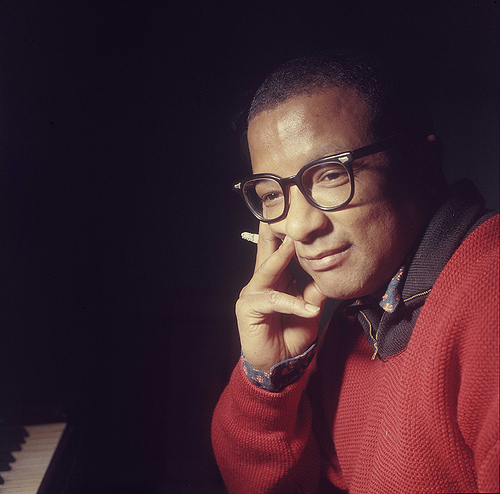
Billy Strayhorn
Mr. Strayhorn, are you familiar with Sean Dobbins, Kurt Krahnke and Tad Weed? They’re Michigan based jazz musicians. Around the state, they’re known as the DKW Trio. In 2009, they released “The Music of Ellington & Strayhorn: Swing is the Thing Vol. 1”. At Orchestra Hall, last Wednesday, I interviewed drummer Sean Dobbins for an upcoming article for the weekly newspaper the Metrotimes. Dobbins runs Civic Jazz , a jazz program for kids sponsored by the Detroit Symphony Orchestra. After the interview, Dobbins gave me a copy of “Swing is the Thing Vol. 1”. Before I talk about the album, I will share with you bits of each member’s background.Dobbins is a sought after drummer. He was a member of the ultra hip jazz ensemble Urban Transport. A few years ago, he started his own band Sean Dobbins and the Modern Jazz Messengers. The Messengers are popular now, and at their concerts Dobbins has a knack for channeling the spirit of Art Blakey, Dobbins’ musical hero. Bassist Kurt Krahnke studied at the New England Conservatory and graduated from Berklee College of Music. He’s played with some heavyweight jazz musicians such as saxophonist Joe Henderson and Jimmy Giuffre. Krahnke has built a solid reputation. Pianist Tad Weed has the most diverse music portfolio, having done stints with Paul Anka and free-jazz saxophonist Charles Lloyd. The DKW is a sophisticated trio, and they did a wonderful job of performing some of the music you co-wrote with Mr. Ellington. The DKW Trio is a democracy. However, on "Swing is the Thing", Weed stands out the most, and it’s easy to mistake him for the leader. Weed has the most Kodak moments. He plays gutbucket blues licks on “Do Nothin’ ‘Till You Hear from Me”. His stride piano prelude on “Daydream” was brilliant. It would’ve made Jimmy “The Lion” Smith a little jealous. There’s an unforgettable moment on “Take the “A: Train” where Dobbins makes his drums talk, but other than that he keeps a low profile throughout the album.
Mr. Strayhorn, I have your P.O , Box address in heaven, so I'll FedEx you a copy of “Swing is the Thing”. I bet you will like it, and the next time the DKW Trio performs, I will let you know in advance. Maybe if you aren’t busy you will attend.

Saturday, October 16, 2010

SHOWING OUT

Johnny O'Neal (photo by Frank De Blase)
You covered a lot of ground Friday night at the Dirty Dog Jazz CafĂ©’. To recap for those who missed the concert, you opened the set with the Stevie Wonder favorite “Overjoyed”, taking the melody on a few improvisational excursions. Next, you performed the Billy Preston ditty “With You I’ m Born Again”. From there you volleyed from jazz standards to blues tunes you concocted on the spot. The blues you sang kept the crowd pumped. The talkative fellow seated next to me at the bar kept grabbing my shoulder, telling me how great your voice was. This year, I have attended many good jazz concerts, but your set left a mark.

You know how to wow an audience. Plus, you kept your cool when some of rude patrons talked during the show. The talkative fellow’s date asked about your background. She was amazed you could play more than one style of jazz. I explained your dad Johnny O’Neal Sr. was a big shot jazz pianist and vocalist around Detroit. As a teenager, you hung out at many of his local performances. He bought you a piano, and you taught yourself to play. Many years later, you got your big break in New York when the drummer and bandleader Art Blakey hired you. I stopped there because you called “Sudan Blue”, a tune you performed often as a Jazz Messenger, and I wanted to hear Sean Dobbins’ solo. The drummer and bassist Marion Hayden complemented you because they are just as versatile.

Dobbins has matured a lot over the years. Early in his career, he was accustom to showboating when the spirit hit him, making funny faces, and twirling his drumsticks in the air. At first, the showboating was cute, but over time, it became annoying. That changed, however, when Dobbins struck out on his own, and formed the ensemble Sean Dobbins and the Modern Jazz Messengers. Last night, Dobbins soloing was discreet, and he never had a hey-mom-look-at-me flashback.

As for Hayden, a student of hers from the University of Michigan Dearborn attended the show. He asked my opinion of her. I explained Hayden is a priceless jazz bassist. She never grandstands or takes long solos. Musically, she has plenty of mother wit, always giving her band-mate support, but she never babies them. All night long, she kept time better than an alarm clock. Dobbins and Hayden were a dynamic supporting cast. The enthusiastic crowd showered your trio with appreciation all night. The more they applauded the harder you all worked.

Monday, October 11, 2010

Pianist Gerald Clayton
I was concerned I wouldn’t get to hear your final set Saturday night at the Dirty Dog Jazz CafĂ©. When I arrived, people were waiting to get inside. Fortunately, I bumped into Andre and Lisa Reid, friends from high school. They were next on the waiting list, and Lisa knew the hostess. She set them at a table with enough room for a third person, so my friends invited me to join them. They’re celebrating their eleventh anniversary. 'Dre even paid for my drink. Lisa picked the restaurant, and 'Dre was anxious to hear your band-mate drummer Justin Brown. Lisa has become a serious jazz fan. Before the set began, she talked about the wonderful time she had at the Detroit jazz fest this year, and she likes saxophonist Stan Getz and Abby Lincoln. My friends heard you’re a promising jazz pianist and bandleader, but that’s all they knew about you, so as an anniversary gift, I shared some of your history. I told them you’re 26-year-old, and you’re born in the Netherlands, but you grew up in California. You served an apprenticeship in trumpeter Roy Hargrove’s band. At the Detroit Jazz fest in 2008, I heard you play for the first time. Your style caught me off guard. Many jazz pianists play the piano as though they’re mad at it. At the jazz fest, you played gracefully. I yapped on and on about your solo performance at the Detroit Groove Society concert series in 2009.

That afternoon, you performed every form of African-American music. I told my friends you come from a musical family. Your pop, John Clayton, is a Grammy winner and an internationally known jazz bassist and composer. Your uncle, Jeff, is an outstanding alto saxophonist. My friends asked about your discography. I explained you’ve only been a bandleader for a few years, so you only have one album on the books as a leader. However, you performed on Hargrove’s excellent album “Ear Food”, and “Brother to Brother” and “The New Song and Dance”, two dates co-led by your pop and uncle. Last year you released a highly anticipated debut “Two-Shade”. I added although “Two-Shade was an impressive coming out album, it failed to capture how gifted you are. Brad Meldau’s influence is evident in your playing. That's all I said about the album of your debut, figuring you’d perform some tracks from “Two-Shade”.

Gerald, I gathered from my friends applauding after each solo, they enjoyed the set. The entire set, Brown’s drum work excited them. 'Dre was hyped. Gerald, I’ve attended many concerts at the Dirty Dog. This was the first time the crowd was attentive. I only have one bone to pick with you. You should've announced the tunes. That’s one of my pet peeves. Oftentimes, jazz musicians neglect to announce or to preface tunes. Anyway, after the set, Lisa asked for my thoughts. Honestly, I’ve heard you swing harder, I told her. The Dirty Dog attracts a conservative crowd. They probably would be unresponsive to a band wilding out. Not to suggest your trio is prone to horsing around. You kept the set respectable. It was ingenious how you stitched together four compositions, playing them as if they’re a suite. It was supernatural how you guys read each other’s thoughts. Your trio was responsible for my friends having a joyous eleventh anniversary although 'Dre complained the $20.00 hamburger he ordered was slightly bigger than a White Castle burger. Nonetheless, they only had wonderful comments about the music.