 |
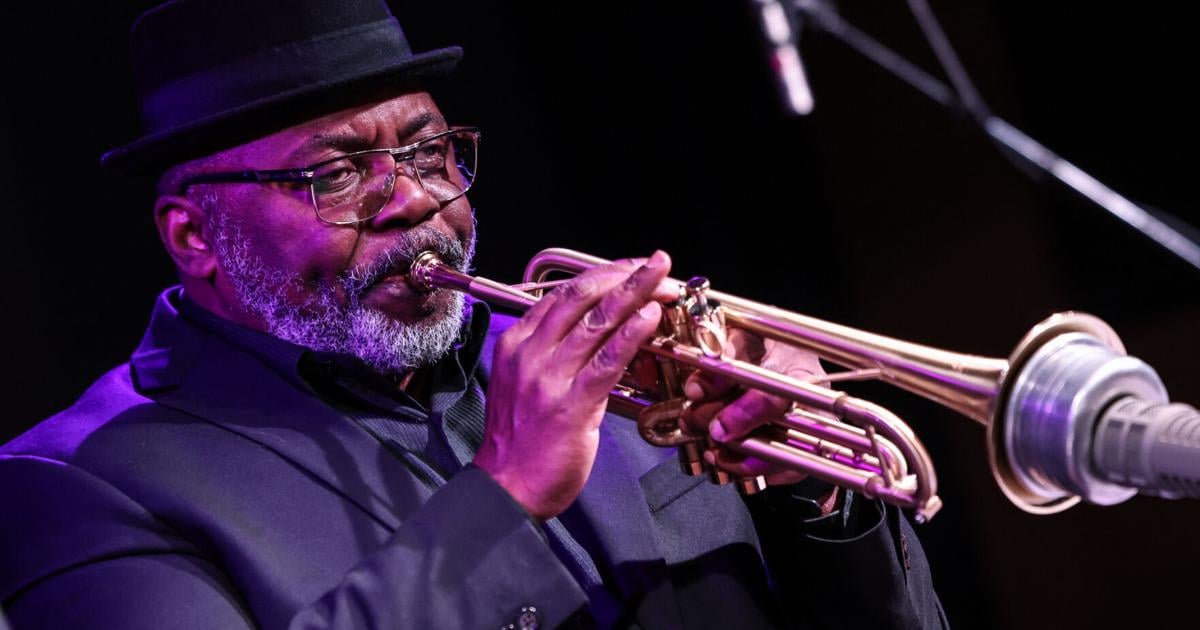
| Trumpeter Dwight Adams |
In
recent years, Detroit’s jazz scene has produced several praiseworthy concert
series. The most prominent has been the Detroit Jazz Preservation
Concert Series, founded by jazz educator and trombonist Vincent Chandler, which
has honored departed Detroit legends like Geri Allen, Donald Walden, Curtis
Fuller, Betty Carter, and Harold McKinney. This year, it expanded its reach to
include active swingers like saxophonists Kasan Belgrave and Marcus Elliot. The
series recently ended its third consecutive year of exceptional programming. DJPCS
set a high bar for any emerging new series. On Friday evening at the Radisson
in Southfield, MI, a new series, the WJZZ Connoisseur Concert Series, debuted.
Rodger Penzabene, Jr., president of WJZZ, started the jazz concert series and chose
trumpeter Dwight Adams’s Quartet for the opening concert. Adams, one of Detroit’s
most enduring jazz stars, delivered the best jazz concert I’ve attended this
year. Adams’s quartet—drummer Andre Wright, pianist Bob Mervak, and bassist
Jeff Pedraz—opened the 90-minute set with Horace Silver’s “Barbara” before
moving into Lee Morgan’s “Mr. Kenyatta.” By the end of the second selection,
the musicians were sweating like union laborers. To give them a breather, Adams
called the ballad “Angel Eyes,” which shifted the attention to Mervak’s vocals,
and he proved to be not only a versatile jazz pianist but also a fine singer.
Mervak’s voice was smooth as patent leather. After the ballad, the quartet
returned to its deep-swinging. Adams was clearly the star, though Pedraz and
Wright delivered goosebump-inducing solos the entire set. Wright’s chops are
akin to the late jazz drummer Pete La Roca in both decisiveness and taste. Like
La Roca, Wright understands a jazz drummer’s first job is to keep time, and he
managed that responsibility all night without the showboating common among other
jazz drummers. As for Adams’s trumpet playing, there is little left to say that
I haven’t already said over the decades I’ve known him. He is one of the last
jazz musicians of the 1990s with an instantly recognizable sound. Within a few
choruses in the upper register of his horn, any seasoned Detroit jazz listener
would know it’s Adams’s voice. After the concert, attorney and avid jazz devotee
Mark Brown told me that Adams is a complete soloist whose improvisations have a
clear beginning, middle, and end. Adams knows how to tell a story through his
solos. That was evident when he waltzed with the changes of “The Last Minute.”
Every moment of the concert qualified as a highlight, especially the arresting
guest appearance by flutist James Russell, who sat in for one tune. The quartet
also performed Adams’s original “The Last Minute,” repurposed Benny Golson’s “Blue
Walk,” and closed with Freddie Hubbard’s “Mr. Clean.” For the encore, Adams
once again cast the zoom lens on Mervak, who thrilled the full house with a
jazzy take of Erykah Badu’s “I’ll See You Next Lifetime.” The WJZZ Connoisseur
Concert Series clearly met the high standard set by the Detroit Jazz
Preservation Concert Series, and Adams raised expectations even further for the
jazz bands Penzabene Jr. has lined up next. Also worth mentioning is that many
of the jazz fans who attend the DJPCS were in attendance. Unfortunately, Penzabene
Jr. announced the date of the next concert but did not reveal who the band is.


