 |
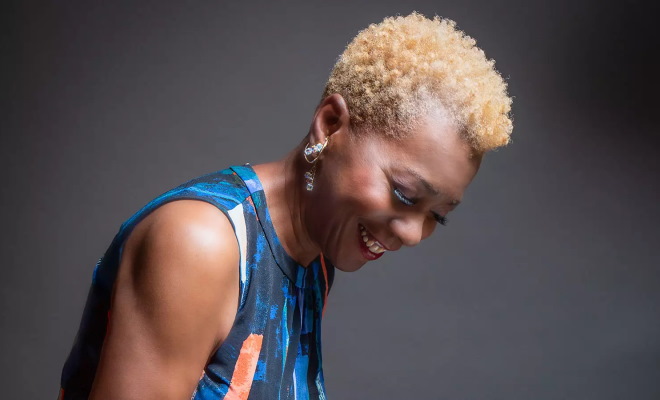
| Carmen Lundy |
At
the 2026 Concert of Colors at the Detroit Institute of Arts on Sunday evening,
jazz vocalist Carmen Lundy proved the widely held belief that the human voice
is an instrument. I first heard that years ago from the renowned Detroit jazz
radio host Ed Love, and it has stayed with me. I hadn’t experienced it
firsthand until Lundy’s performance that Sunday. Her ability to make her voice
sound like an instrument sets her apart from her peers. Her stage presence is
equally engaging. Lundy never spends her set reinterpreting jazz standards;
instead, she draws from her discography. Sunday, she started with “Blue Woman,”
then seamlessly moved into “Lonesome Blue Butterfly” and “Lone Journey Home,”
composed by her brother, bassist Curtis Lundy. When she ended “Old Friends,” I
bet most attendees had tears in their eyes. She clearly embodies
near-superhuman powers, able to evoke and manipulate every emotion imaginable.
But the true joy isn’t always in hearing her sing from the far reaches of her
soul; it’s in watching how she inspires her bandmates. For this concert, her
band included her brother Curtis, guitarist Andrew Renfroe, drummer Terron
Gully, and the rising pianist Sequoia "Redwood" Snyder. Her touch and
temperament at the piano resemble those of the late Geri Allen, and Snyder was
unquestionably Lundy’s favorite band member, brimming with pride as Snyder
played with grace, color, and self-assurance. Man, the young lady can swing
when encouraged. At a young age, she understands the mechanics of accompanying
a world-class vocalist. Although Lundy believes in sharing the spotlight, the
near-flawless set hinged on her voice—that wonderful instrument.
Before
saxophonist Gary Bartz blew the audience out of their seats at the DIA after
Carmen Lundy’s set, he told the audience that he and his band, bassist Ralphe
Armstrong, drummer Eric Kennedy, pianist Joe Block, and guitarist Paul
Bollenbeck, would perform the set without commercial interruptions. They
planned to swing and only come up for air if necessary. They never broke stride.
At 85, Bartz sounded even more robust and together than when he ran the streets
with Art Blakey, Charles Mingus, and Miles Davis. Bartz never revealed the
setlist, but the music, an amalgamation of bop, funk, R&B, and free jazz,
came off like one extended composition designed for the Concert of Colors.
Honestly, I only planned to stay for a few of the tunes in Bartz’s set. I was
there for Lundy, and she didn’t disappoint. Twenty minutes into Bartz’s set, I
couldn’t in good conscience leave such a marvelous improvisational swing fest.
It was the first time I had heard him live with his own band. I'm not sure if
this band is his regular touring band. I know Armstrong was a last-minute
replacement for Bartz’s regular bassist. Anyway, collectively they were tighter
than a size 10 foot in a size eight dress shoe. Their individual solos were as
satisfying as home cooking, especially those of Bollenbeck and Kennedy. He’s one
of those likable jazz drummers who never tries to be the center of attention.
His drumming is direct, and he is a stickler for time management. Each member
was a perfect complement to Bartz's worldly swing ethic.
Gary Bartz

