Tuesday, November 10, 2009

DANA'S COMING OUT PARTY

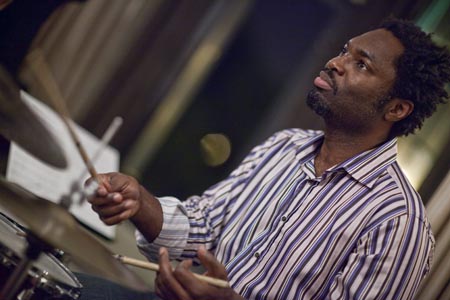
Drummer Dana HallDana, you've logged many man-hours as a sideman, working for jazz greats such as the late tenor saxophonist Joe Henderson, vocalist Maria Schneider, and pianist Kenny Barron. With the soon to be released, "Into the Light", your debut album, you'll show a wider audience what you're made of. Your resume' is too enormous too talk about so I'll just comment on "Into the Light", which will be on my favorite album of 2009 list.

Do you value jazz bloggers and critics take on your work? I hope you will take my comments to heart. "Into the Light" is a fun coming out party. I bet your band-mates trumpeter Terell Stafford, tenor sax player Tim Warfield, bassist Rodney Whitaker and piano player Bruce Barth would've done the gig for free if you had ask them. You know the quality of talent needed to make a good jazz album. Neither musician had to change the way they play. Their styles blended with yours, and you engaged and challenged them from start to finish.

On the opener, "I Have a Dream", Tim Warfield ate the changes like a home cooked meal. When Stafford soloed, he made my car speakers smoke. Whitaker, and Barth, both noted swingers, did not make a fuss. They kept time and guided the band through the course that you mapped out.

Whitaker played a lovely solo on "For Rockelle", which he wrote. (It appeared the bassist borrowed heavily from the structure of "My Funny Valentine.) The title cut "Into the Light" was a free jazz field trip. I got lost in the various tempo changes, and it was the most reckless I ever heard Warfield blow. You slugged it out with Warfield on "Jabali". You and Barth had an heated improvisational debate on "Tin Soldier". Whenever you soloed, Dana, I heard drummers Joe Chambers, Art Blakey, and Jeff "Tain" Watts influence on you. You ought to be proud of this debut album. It is almost flawless.

Origin Records will release "Into the Light Tuesday November 17, 2009.

Saturday, November 7, 2009

SWEET VOICE

Friday night is date night. I take my wife to dinner or to a movie. Sometimes I do both. Yesterday, driving to the Thai Bistro in Grosse Pointe, we listened to your album "Dream Dancing". The album had us in a trance. At dinner, my wife asked about you, and the rhythm section, which she really liked. I told her I heard you for the first time at Baker's Keyboard Lounge a few weeks ago, singing with the vocal jazz quartet Metro Jazz Voices. The wife said your voice is lovely, and your strength is singing love songs. On "Darn That Dream" and Sweet Dreams" you voice is satisfying as comfort food.

Meri, I think the wife is trying to replace me as the family jazz critic. My wife pats her hand on her knee when she is really into a piece of music, but while your album was on, she also did a little slow dance in the car seat, which meant she loved your album. Before we reached the restaurant, she had me replay "All Night Long" twice. Of the eleven songs on the album, that's her absolute favorite. I like the entire album. Tenor saxophonist Carl Cafagna and pianist Scott Gwinnell are good in their supporting roles. They are powerful players, but they don't overpower you.

This year, I've received many album my female jazz vocalists. Some were noteworthy, and others not so. "Dream Dancing" is one of the best I have experienced. I disliked the other vocalists albums because of the arrangements. They had string accompaniment, which overwhelm them. That's not the case on your album.

On "Close Your Eyes" and Corcovado (Quiet Nights), for example, your voice blends nicely with the string instruments like butter melting on a stack of pancakes. The eleven songs you chose for this album fit your voice perfectly. My wife asked if I had written about "Dream Dancing" yet. I said I had not because the album is three years old. I only review current releases. She said I should post a review anyway. This is a great album no matter when it came out. Then she gave be a short lecture, saying I should use my jazz blog to help local jazz musicians, and I should encourage my readers to buy “Dream Dancing.

Wednesday, November 4, 2009

CARL IN CHARGE

At 10:00am, I played "carl cafagna & northstar jazz Live at the detroit jazz festival”. It is 11:05pm now, Carl, and I’m still listening to it. I carried the album with me while I ran a few errands. Driving to Mississippi Muscle Gym in St. Clair Shore for my Tuesday afternoon workout, I played it. I pretended I subbed for you on “Waxwing”, while showering after my workout. In my mind, I sped through the chord changes, and the crowd went nuts. Shopping for a bookcase at Pier 1 I strolled about humming the melody to “Liberty (Elvin’s joint)”.

As I write this post, I’m playing the album yet again. I’m hooked. Carl, Northstar Jazz is a fantastic sextet. For nearly a decade, post-bop bands such as Bop Culture, Urban Transport, Sean Dobbins and the New Jazz Messengers, and the Hot Club of Detroit have surfaced on the Detroit jazz landscape.

This year, I've seen you in various roles. I heard you for the first time with the Scott Gwinnell Orchestra and the Hot Club of Detroit this summer. Last week, I heard you sing with the Metro Jazz Voices at Baker’s. On “carl cafagna & northstar Live at the detroit jazz festival”, which I bought at that night, I’m experiencing you as a boss.

You are a self-less bandleader. Did you form this band as a showcase for your band-mates trumpeter Dr. Scott Cowan, saxophonist James Hughes, bassist Shannon Wade, drummer Scott Kretzer, and pianist Scott Gwinnell? It appeared so. Gwinnell really stood out. On the "Soulful Mr. Timmons", written by pianist James Williams for the late pianist Bobby Timmons, Gwinnell played as if Timmons' spirit was standing over Gwinnell's shoulder encouraging him.

Carl, I was hard on you in my review of the Metro Jazz Voices performance last week. I wondered why some saxophone players want to sing. Are you all frustrated singers? I said your singing was rough. On “Live at the Detroit jazz festival”, I enjoyed when you sang “Just a Close Walk with Thee". I liked spending time with your album today. It’s close to mid-night. Time for me to finally put the album away, and go to bed.

Friday, October 30, 2009

JAM BAND

Dear Jeff Lavenson,

The new James Carter album "Heaven on Earth" recorded live at the Blue Note jazz club in New York came out in late August unbeknownst to many of Carter’s hometown fans. Why wasn’t there a media blitz? As a jazz journalist and as a James Carter fan, I was disappointed. By the way, I'm Charles L. Latimer I write about jazz for the Metrotimes, a weekly newspaper in Detroit. Folks around town were in the dark about “Heaven on Earth”.

I discovered the album on Amazon.com months after it hit the streets. Why didn't I buy it from Amazon? I don't care to order music online. I support neighborhood record stores, which nowadays are an endangered species. Car City Records and Melodies and Memories, record stores near Detroit that sale jazz music didn’t stock the album. They didn’t know it existed. Jeff, why didn't Half Note Records have an aggressive marketing campaign? The people who handle publicity for the label dropped the ball.

Detroit is a jazz town with a rich jazz history, and most Detroit jazz fans consider Carter royalty. We should’ve known about this new album months in advance. For weeks, I search locally for the album. I finally tracked it down over the weekend at Street Corner Music, a record store in Southfield, MI. "Heaven on Earth" is Carter’s best live album.

Live is the best context to experience him. In his live performances, he holds nothing back. Carter is like a ventriloquist, making his sax talk. The liner notes said you put together this album, handpicking Carter's sidemen. Bassist Christian McBride, organist John Medeski, drummer Joey Baron, and guitarist Adams Rogers are Carter's equals. I replayed "Blue Leo" and the title cut many times. Organist John Medeski had me spell bounded. It was the first time I heard him. He has a churchy sound on the organ like a gospel choir lives inside it. Medeski could’ve been easily mistaking as the leader. He scrambled through the tunes like a college quarterback.

"Heaven on Earth" is an excellent jam band record without the egos. Each player had his moment in the spotlight, and they didn't disappoint. McBride, for example, handled his bass like a debutante on "Diminishing". Rogers had the six stings on his guitar groaning on "Blue Leo". The players never tried to outfox Carter. Carter is a middle-aged saxophonist now. The past five years his playing has matured. He’s no longer unnecessarily rambunctious. He’s learned how to edit himself, especially when improvising. His maturity is evident on “Slam’s Mishap” and “Street of Dreams”. His soloing and improvising is pointed.

Jeff, what's next for this band? Will they tour? Are you planning to do a studio recording with them? If you are, give us James Carter fan some advance notice.

Best,
Charles

Thursday, October 29, 2009

MEET THE JONES

Pianist Oliver Jones and Hank Jones
Twice a month, Hank I take my mother out on the town. Sometimes we catch a movie. Sometimes we go shopping. Sometimes we have lunch, and talk for hours. My mother name is Ernestine. She turns 62 next month, but she looks decades younger. She likes being flattered. Five years ago, Hank, she retired from Chrysler. Thirty-two years she toiled at their gear and axle plant on Van Dyke and Lynch Rd, in a dilapidated neighborhood. Mom is generous, cynical, and strong. I attended her retirement party that her co-workers organized it.

That was the first time I stepped foot in the plant. The plant was noisy. The floors were greasy. The workers moved like zombies. I don't know how mom survived working there all those years. She had some great co-workers she treated like family. Be bop, mom’s main running-buddy. She retired two years after mom. Her friends nicknamed her Be bop because she talks fast than Charlie Parker played the changes to "Confirmation".

-At Thanksgivings dinner last year, for example, Be bop yapped for two hours straight. Listening to her carry on, I thought about how John Coltrane could solo for hours. Mom and Be bop travel often because they’re retired. I love to spend time with mom. My brother and sister live in North Carolina. Mom doesn’t get to visit them often. They call her weekly, and mom will spend Christmas with them.

-Hank, you’re probably wondering why I’m sharing this with you. Sunday, we went to the AMC Star Gratiot theater to see comic Chris Rock’s new movie "Good Hair", a documentary about African-American women obsession with their hair. The movie was good. You should check it out. Driving to the AMC Star, we listened to your new album “Pleased to Mee You”, which you co-led with pianist Oliver Jones. Is Oliver a relative? The liner notes didn’t say. DL Media sent me the album, but not a press release. Mom isn’t a jazz buff, but she loves music. She thinks smooth jazz saxophonist Boney James and Najee are jazz musicians. Currently, she loves Keyshia Cole, an R&B singer.

-Mom adored “Pleased to Meet You”. She was curious about your background. I told her you’re from a prestigious jazz family. Your brother’s trumpeter Thad and drummer Elvin accomplished a lot musically. You all grew up in Pontiac, Michigan. Looking at the “Pleased to Meet You” album cover, she couldn't believe you're 92. I took her about your hot performance at the Detroit International Jazz Festival last month.

-Mom patted her right foot and bobbed her head from track one "What Am I Here for" to track 11 "Lonely Woman". She also enjoyed Oliver Jones playing, but I couldn’t give her any information about him. It was the first time I'd experienced Oliver. He’s a fine piano player with a sophisticated left hand, and a right hand that gallops across the piano keys.

On the standard "Making Whoopee", it appeared you and Oliver played one piano at the same time. Mom’s favorite tracks were "Blues for Big Scotia" and "Monk's Mood". At some point, I thought I'd have to stop my car, let her out so she could dance. You and Oliver had her in a trance. I'm going to buy her a copy of "Pleased to Meet You". I’ve noticed; as she’s gotten older, her musical taste has changed. From Keyshia Cole to a budding Hank Jones fan that’s a big leap. I might turn mom onto Thad and Elvin’s music next.

Tuesday, October 27, 2009

ON THE BRINK

Carl Cafagna, Jeremy St. Martin, Nicci Der-Stepanian, and Meri SlavenAfter the Metro Jazz Voices second performance, Meri you asked me for feedback. Normally, Baker’s features straight ahead acoustic jazz. I like the idea of having a jazz quartet comprised of vocalists in the tradition of Lambert, Kendricks, and Ross, and the Manhattan Transfer with a strong presence on the Detroit jazz scene. At Baker’s Keyboard Lounge last night, the MVJ show promised, performing songs such as Frank Sintra’s “Look of Love”, Oscar Peterson’s “Hymn of Freedom” and Stanley Turrentine’s “Sugar”. MVJ has some strengths and noticeable weaknesses that should be addressed.

Of the four singers, you and Nicci Der-Stepanian were more polished. On "Over the Rainbow”, Der-Stepanian was divine, and you stayed poised when the microphone kept fading in an out while you sang of "Pennies from Heaven". Meri, your voice is sweet. You are the more polished singer. I believe you know that, but you never tried to upstage your band-mates.

Founder Jeremy St. Martin and Carl Cafagna were the loose links. Cafagna-the front man of Carl Cafagna & Northstar Jazz, and a key member of the Hot Club of Detroit--is a wonderful tenor saxophonist, but he’s not a natural singer. His attempt to riff like vocalist John Hendricks was brave, but Cafagna flopped. MJV’s founder, Jeremy St. Martin, was shy. I would've never guessed the quartet is his brainchild. Cafagna behaved like the ringleader. Maybe St. Martin dislikes the spotlight. Maybe from day one he decided to delegate the workload.

Hiring the Scott Gwinnell trio was smart. They know how to back vocalists. Gwinnell is multi-faceted. This summer, he released the album “Brush Fire” His orchestra rocked the Detroit International Jazz Festival last month. The album, I bet, will make many jazz critics best of 2009 list. It’ll be on mine. Meri MJV has promise. With more rehearsing, and a year or two of gigging steadily, the quartet will be tighter. Conventional jazz bands have overpopulated the Detroit jazz scene. It needs more diversity. The MJ V has a sturdy foundation to build on

Saturday, October 24, 2009

CLARINETIST SINGS AND SWINGS

Wendell, when did you start singing? I planned to question you after your opening set at the jazz club Cliff Bell's Saturday night. I couldn’t because some fans had you cornered. Wendell, I know some saxophonists past and present liked to sing. Several years ago, for example, I heard Archie Shepp sing. It was an ugly site. Recently, I watched video footage of the late saxophonist George Adams singing. He was a remarkable free-jazz saxophonist, but Adams singing was underwhelming. Skeeter Shelton, another gifted free-jazz sax-man, sang during his gig in 2007 at the Bohemian National Home. It was embarrassing.

The crowd at Cliff Bells was noisy. I could barely hear you. So I cannot say how you fared. You seemed confident. Your knack for sashaying through chord changes with the clarinet was comparable to Pee Wee Russell and Benny Goodman, clarinetists I'm sure influenced you. If they were alive, Russell and Goodman would consider you a peer. I couldn't hear your singing voice, but I could hear your rhythm section They were like enthusiastic disciples setting at the feet of a jazz sage. In fact, I set at a table on the stage, close enough to bassist Jef Reynolds I could see the notes floating away from his bass strings, and melting in the crowd ears.

During the intermission, I chatted with guitarists Bourassa and Niko Pittman. He shared the ensemble's history, saying you formed the Detroit Swing Ensemble five years ago, mixing big band era swing and be bop, which explained why your sets included material by Louis Jordan and Charlie Parker.

Wendell you sounded complete like on your solo album "The Eight House Riding with Pluto". I overheard you tell someone you've been touring in London and Japan with a band called "Tribe". Doing so keeps you alive. Pittman said closed his law practice to play music full-time. Bourassa gives guitar lessons online. He has students overseas. They gushed about your generosity. Reynolds retired to the dressing room before I had a chance to question him.

The rhythm section was tight knit like firefighters. On the Charlie Parker selections the ensemble performed, Reynolds walked the upright bass around the club as if the bass was a show pony. On a ballad, tears streamed down guitarist Rob Bourassa's guitar strings. Pittman's guitar spoke fluent 1930-ish swings and be bop. The group switched from swing to bop quicker than a couch potato changing television channels. I hate the audience chatter muffled your voice. Maybe the next time the Detroit Swing Ensemble performs in Detroit it'll be at a club where the audience is there is experience great jazz music.