Sunday, August 31, 2014

FOUR NOTEWORTHY SETS FROM THE FIRST FULL DAY OF CONCERTS AT THE DETROIT JAZZ FEST

Cyrus Chestnut
Saturday, marked the first full day of concerts at the 35th Detroit Jazz Festival. Although I got an early start, I didn’t catch all the concerts I planned to. I started the day at the Absopure Pyramid Stage. I caught Hallady/Schunk Latin Experience set. The group of Detroiters played from Doug Halladay’s latest album “Celebrando!”.

I bumped into Halladay’s wife opening night of the festival. She implored me to check out the set, promising it would be smoking. She was right although there was some overkill. The soloing was too long. I wondered if the first two numbers would ever end. Hallady is a fine composer and he put together a solid group of Detroiters to play his music. If this band stays together, it will be one of the best in Michigan.

After Hallady’s set, I shot over to catch alto saxophonist Phil Woods’ set at the JP Morgan Chase Main Stage. Woods is one of a handful of remaining players from the bop era, and although he had to me wheeled onto the stage and he carries an oxygen tank to help him breathe, he still sounds wonderful. His chops hasn’t aged one bit.

His band trumpeter Brian Lynch, pianist Bill Mays, bassist Steve Gilmore and drummer Bill Goodwin sprinted through a number of goodies from the American Songbook. Woods had to take a break after a couple of meaty solos. Emphysema has slowed him down some. Woods made light of his medical condition, joking that when a saxophonist is hit with emphysema it’s a sure sign he plays too many notes.

I stayed at the Chase Stage. Pianist Cyrus Chestnut followed Woods. Chestnut had a young band with him who looked like high school music students, but they swung like veteran players. Chestnut set was a tribute to the late great jazz pianist Dave Brubeck. 

Chestnut did an excellent job remaking many of Brubeck’s signature tunes. The crowd had a collective orgasm when Chestnut broke into the hippest take of “Take Five” I ever heard, a classic written by Brubeck’s band-mate Paul Desmond.

Before the set started, Chestnut warned the crowd he did not intend to play Brubeck’s music as originally written. It was Chestnut's first stop at the Detroit Jazz Festival since 1992. 

Saxophonist Pharoah Sanders was the musician I wanted to see the most. I wondered if Sanders was still deep into his free-jazz bag. Sanders played a straight-ahead set with little of the antics on the sax he’s known for. 

Sanders didn’t announce the tunes his band played. The crowd was so wrapped up into the performance they really didn’t give a damn. Sanders gave them what they wanted undiluted jazz and brilliant soloing from his staff drummer Joe Farnsworth, pianist Will Henderson and bassist Nat Reeves.  So far, my favorite set of the festival

Saturday, August 30, 2014

THE 35TH DETROIT JAZZ FESTIVAL OPENED FRIDAY EVENING WITH A TERRIFIC SET FROM BAD PLUS FEATURING JOSHUA REDMAN

Bad Plus & Joshua Redman
After 25 minutes of backslapping by the big sponsors of the Detroit Jazz Festival, the 35th installment of the nation’s largest free music festival opened with a brilliant set from the jazz trio Bad Plus. Drummer David King, bassist Reid Anderson and pianist Ethan Iverson make up the trio, and their special guest was saxophonist Joshua Redman, the DJF’s artist-in-residence. Honestly, the Bad Plus’s set would’ve been badass without Redman, but his being there was a bonus.

The Bad Plus is a tough band to label. One minute they played what appeared to be rock fusion. The next they stretched out on a free-jazz piece. Then they slipped in a ballad played so lovingly it would've made a stingy bastard donate his life-savings to charity.

Bad Plus kept changing the game plan, playing a bunch of multi-layered original compositions the conservative DJF crowd ate up. Redman was terrific throughout. You could follow the logic of his playing whether he played mellowly as he did on the set opener “Love is the Answer,” or played wildly as he did on the set closer. Anderson wasn't being cocky when he said the band's performance set the tone of the festival.

The second set was billed A Night at the Apollo starring Ted Louis, Margot B, Kevin Mahogany, the Wonder Twins and David Berger’s NYC Big Band. It was a big project design for the DJF. On paper, the project seemed easy to pull off. But the result was a cluster fuck.

Berger’s Big Band was on point playing swing, bebop, and the blues with heart, energy and efficiency. The other acts were flat. Ted Louis is a competent tap dancer and singer. But his impression of Sammy Davis Jr. and Cab Calloway were lame. The Wonder Twins dance routine was puzzling. Kevin Mahogany is a great jazz singer, one of the best in jazz. But his booming voice couldn’t rescue the set.

Mahogany did get a brief rise from the crowd when he belted a blues, his best punch. If Berger’s big band had played the set alone, it would’ve been good enough to maintain the spirited tone Bad Plus had established. 

Sunday, August 24, 2014

UPCOMING TALK WITH RANDY WESTON & BILLY HARPER AT THE DETROIT JAZZ FESTIVAL

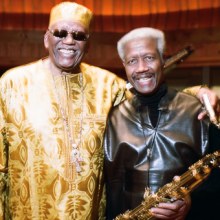
Randy Weston and Billy Harper
July was a good month. I received a bunch of excellent jazz albums, and I picked up writing drive-by album reviews. The kind of reviews that come in under 100 words. A former music editor at the Metrotimes--a weekly newspaper in Detroit where I covered jazz for 17 years--coined the name years ago. I continued using it because it fits the short reviews I enjoy writing. 

Anyway, I spent the better part of July listening to new music. Saxophonist Sonny Rollins' and pianist Cyrus Chestnut's albums were the best followed by bassist Rodney Whitaker and pianists Eric Reed and Orrin Evans.

In August, things have slowed down, which is OK. The Detroit Jazz Festival is around the corner. My friend jazz historian Jim Gallert asked me to interview pianist Randy Weston and saxophonist Billy Harper at the Jazz Talk Tent.

At first, I turned Jim down because I’m uncomfortable talking to crowds. I’ve interviewed many jazz musicians mostly one on one or via telephone. Jim is a salesman at heart, and he convinced me I’m the right man to conduct the interview. 

The past three weeks, I’ve been researching Weston and Harper. I’ve talked to jazz legends before. In fact, I’m an old pro at it, having picked the brains of Wayne Shorter, Sonny Rollins, Horace Silver, Richard Davis and many others.

I bought Weston’s autobiography “African Rhythms”. It’s taken me a week to get through it. Weston led an upstanding life and that doesn’t make for riveting reading as Hampton Hawes’, Miles Davis’ and Art Pepper’s autobiographies was. They led troubled lives.

Anyway, I got some useful information from Weston’s book, particularly his musical partnership with trombonist Melba Liston which Weston likened to Duke Ellington and Billy Strayhorn's partnership.

I couldn’t find a lot of information about Harper. I checked All Music, All About Jazz, Harper’s official website and a few more online sources. All had the same basic biographical stuff so I won’t have a ton of questions for him. 

Weston and Harper put out a wonderful album in 2013 titled “Roots of the Blues”. I plan to make it the thrust of the interview. I want to know about their musical friendship and how it’s grown over the years. They’ve been collaborating for decades. I’ll warm up with that. Then I’ll question them about memorable chunks of their musical history. That should eat up most of the 45 minutes I have to interview them. 

Saturday, July 26, 2014

AN ADVANCE PEEK AT NEW MUSIC COMING SOON FROM BOBBY BROOM, RODNEY WHITAKER & ERIC REED

The jazz guitarist Bobby Broom last album was "Upper Westside Stories". He packed it with new music, and for the first time fans were able to take in the full range of his writing. It was a wonderful and a daring outing. For Broom’s new album "My Shining Hour," available August 19th on Origin Records, Broom drummer Makaya McCraven and bassist Dennis Carrol reworks some well-known tunes from the great American Songbook such as "My Ideal," “Just One of Those Things," "Jitterbug Waltz" and "Sweet Georgia Brown". It wouldn't be wrong to feel some of Broom’s best work is his take on music of renowned composers. This new album is on par with one of Broom's best dates "Bobby Broom Plays For Monk". Throughout "My Shining Hour" Broom strums so sweetly it would make the devil stop sinning. Whenever Broom picks up his guitar whether for a live set or for a studio date bank on some topflight jazz.
"When We Find Ourselves Alone" is jazz bassist Rodney Whitaker's third date for Mack Avenue Records and his first without his partner drummer Carl Allen. These days, Whitaker's hands are full running the Jazz Studies Department at Michigan State University and playing with a group of department staffers known around campus as the Professors of Jazz. So, his recording output has slowed down a bit. This new album marks Whitaker's return to the stellar post hard-bop music he put out during the late 90’s. Whitaker also reunites with players he's run the streets with in the past pianist Bruce Barth, drummer Gregory Hutchinson and saxophonist Antonio Hart. Hart is the centerpiece of this album, and arguably one underappreciated saxophonist. An added feature is Whitaker's daughter Rockelle Fortin, a fine vocalist on the move who doesn't blow the opportunity here her dad gives her. Fortin sings on five of the cuts. "When We Fine Ourselves Alone" is a darn good album, marking a welcomed return to Whitaker's roots.

I laughed reading pianist Eric Reed's main goal for his new date "Groovewise" was to make a great album. What was so amusing? Reed is one of jazz's elite pianist and he’s been making great music for a while. No doubt, Reed could make a great album in his sleep. Reed recorded live at Smoke in New York. The album is coming out September 9th on Smoke Sessions Records. It fines Reed working with his quartet that has saxophonist Seamus Blake. Its unfortunate a sax player as terrific as Blake isn't a household name. Reed allows Blake to carry this album, and Blake does so proudly. The crowd killers on this date are “Until the Last Cat has Swung” and “Groovewise (Intro).

Friday, July 18, 2014

NEW SESSIONS FROM SEAN JONES & ORRIN EVANS ARE COMING

Trumpeter Sean Jones has been with Mack Avenue Records for 10 years. He's celebrating that achievement with the release of his 7th studio album "im-provise never before seen" out Tuesday July 22nd. Jones has made some terrific jazz albums for Mack Avenue such as "No Need for Words" and "Roots," but none as well thought out as this one. He made it with pianist Orrin Evans, bassist Luques Curtis and drummer Obed Calvaire musicians, Jones has performed with for years. The album opens with "60th & Broadway," a burner that will make the hairs on your neck catch fire. Jones’ exchange between Evans on "Interior Motive" seems as if they're playing the dozens. The ballads on the album are perfect. No trumpeter plays ballads as beautifully as Jones does. His blowing on "Morning After" and "Not While I'm Around" will make your soul weep.


"Liberation Blues" is jazz pianist Orrin Evans third live album. Smoke Session Records, which is putting out live dates from some big shot jazz pianists, releases this album August 12th. This outing is an all-star date with two of the top names in jazz right now saxophonist JD Allen and trumpeter Sean Jones. (Drummer Bill Stewart and bassist Luques Curtis round out the rhythm section.) Evans has been throwing down for 20 plus years without all the press and hoopla lavished on other jazz pianists of his generation. Still, Evans is beloved by his peers and by serious jazz devotees. Evans has made 20 albums. "Liberation Blues" is the latest gem, showing he knows how to manage an all-star band among other things. The album starts with "Liberation Blues," a suite for Evans' departed band-mate Dwayne Bruno. The first two movements “Devil Eyes” and Juanita Bruno composed and are the most enticing. Overall, the album offers a complete picture of Evans, a pianist with impeccable manners not afraid to think outside the box. Putting together Allen, a deep thinking sax player with Jones who breathes, drinks, and eats swing is a gamble that pays off.

Wednesday, July 16, 2014

PIANIST CYRUS CHESTNUT RELEASES A LIVE ALBUM, FINALLY

"Midnight Melodies" is the jazz pianist Cyrus Chestnut's first live album. He made it at Smoke, a favorite jazz club in New York for some jazz pianists. He’s always wanted to make a live album but for whatever reasons just got around to doing one. This is his best trio album in years. 
Since leaving Atlantic Records over a decade ago, some of Chestnut's albums have been below par. He put out a few good ones such as “Journey” and “Spirit,” and some not so good such as “Cyrus Chestnut Plays Elvis” and "Genuine Chestnut". But when he makes a quality album its quality from head to toe.
As for this new album, Chestnut staffs it with bassist Curtis Lundy and drummer Victor Lewis, star players in jazz for some time now, who have a history with the late pianist John Hicks,  Chestnut's mentor.
This album comes off as a nod to Hicks when the trio plays his “Two Heart Beats” “Pocket Full of Blues,” and “Naima’s Love Song”. On the latter, the trio is in full depth. 

Chestnut mixes bits of the hymn “Sweet Hour of Prayer with the standard “For All We Know,” and it works gorgeously. He’s in the moment letting his imagination joyride. 
Sweet as Chestnut's reworking of "Naima's Love Song" is, it isn’t the standout. Milt Jackson's blues "Bag's Groove" is  and it's likely to be played over and over. 
Chestnut opens the blues toying with the melody before blowing it wide open. On it, Chestnut sounds a lot like the pianist Gene Harris when he was in the throes of a blues.
Chestnut always puts the spotlight on his band-mates when fronting larger bands, although he's the leader, he seems comfortable in a supporting role. In this live trio setting,however, he allows himself to thrive. 

Friday, July 11, 2014

'AFROPHYSICIST' IS THE NEW ALBUM FROM RISING STAR THEO CROKER

The jazz trumpeter Theo Croker is the grandson of the late and legendary trumpeter Doc Cheatham. Croker is like him in a few ways. He has a soft tone and his phrasing is smooth like soymilk. Listening to Croker's new album "AfroPhysicist" it's clear he isn't the least bit interested in emulating his granddad, or putting out the kind of jazz he was into. 
Cheatham was a red-blooded American jazz man and a saintly swinger. Every band he played in was blessed to have him. Croker is steep in the traditional inner workings of jazz. He can swing up a storm listen to “The Fundamentals” and he can play angelically as he shows on “Visions” and on “Bo Masekela”.
This album suggests he's on a jazz fusion kick like a growing number of his peers pianist Robert Glasper, vocalist Gretchen Parlato, and trumpeter Christian Scott, which is OK because Croker does the jazz fusion thing exceedingly well. It wouldn't be wrong to regard "AfroPhysicist" as his breakthrough album, or better yet his mission statement to the jazz world. 
"AfroPhysicist is Croker's third album. It has all the markings of a serious jazz musician out to make a name. His kind of jazz fusion is like the listenable fusion Christian Scott has been making.  
The album opens with a nod to Cheatham titled “Alapa”. Croker sounds as if he tries to get in touch with his granddad's spirit. The next cuts “Realize” is a jazz fusion explosion, followed by the mid-ranged goodies “It’s Not You. It’s Me (But You Didn’t Help}” and “Light Skinned Beauty”.
"AfroPhysicist" is on vocalist Dee Dee Bridgewater’s label DDB Records. She pitched in big as producer, and she sings wonderfully on two cuts “Save Your Love for Me” and “Moody’s Mood for Love”.  Her help doesn't make the album, but having her on it doesn't hurt. Croker isn't a household name yet like trumpeters Sean Jones and Terell Stafford are. However, this album is a major step toward the big leagues.