Saturday, April 27, 2013

AT 88, ROY HAYNES STILL KNOWS HOW TO WIN OVER AN AUDIENCE

Drummer Roy Haynes

The jazz drummer Roy Haynes résumé’ is thicker than a collegiate dictionary. Haynes has been involved in every development in jazz which includes swing, bebop, hard bop, free jazz, and jazz fusion. Haynes officially stepped into the limelight in 1947 when he joined the swing era tenor saxophonist Lester Young. Haynes has been in the limelight since. 

As a sideman, Haynes has played with many greats Charlie Parker, Sarah Vaughn, John Coltrane, Eric Dolphy, and Chick Corea. The bandleader section of his résumé’ is also astonishing. To date, Haynes has released roughly three dozen albums.  "We Three," "Cracklin'," "Out of the Afternoon," and "Cymbalism" are jazz masterpieces. As far back as memory serves, Haynes has always been a flashy drummer, and a noted fashionista. 

At 88, the same holds true. Haynes is jazz’s oldest living ham. That was on full display Friday evening at Orchestra Hall in Detroit, Michigan. Haynes’ current band the Fountain of Youth played the second to last concert of the 2013 Paradise Jazz Series. 

At times, the hour plus concert was messy. But the jazz series audience overlooked that. Haynes is the consummate showman, big on audience participation. Besides, Haynes knows how to win over an audience. The young musicians Haynes currently run the streets with saxophonist Jaleel Shaw, pianist Martin Bejerano, and bassist John Sullivan who subbed for David Wong were competent. 

Haynes began the set with Thelonious Monk’s gem “Trinkle Tinkle”. Then before Haynes called the next number, he broke into a tap-dance routine. Surprisingly, Haynes was good at it. 

Normally, Haynes waits until the end of a concert to put on a drum exhibition. Last night, Haynes did so for the third number. It was lengthy, flashy, and Haynes displayed the energy and anticipation of a horny teenager on prom night. 

The evening belonged to Jaleel Shaw as much as it did to Haynes. Shaw is indebted to the great alto saxophonist Charlie Parker. Shaw’s Parker-like manner may explain Haynes attraction to Shaw. On  Thelonious Monk's "Bemsha Swing," Shaw roared like a blood thirsty lion. On the ballads “Star Eyes” and “My Romance,” Shaw played softly as snow landing on cotton. 

Martin Bejerano was off. His solos were a bore. Somehow, he managed to suck the life out the piano. Although the concert was messy in spots, the audience was pleased. They lavished Haynes with a long ovation. They didn’t calm down until Haynes obliged them with an encore. 

At the end of the encore, Haynes did another tap-dance routine. Even though Haynes is nearly 90, he’s still spunky and still able to captivate an audience. Few jazz fans will disagree Haynes remains one of the flashiest jazz drummer out there, and is jazz’s oldest living ham.   

Wednesday, April 24, 2013

THE 2013 DETROIT JAZZ FESTIVAL LINEUP ANNOUNCED


Macy Gray and David Murray


 At the Detroit Athletic Club Tuesday afternoon, organizers of the Detroit Jazz Festival announced the 2013 lineup. It was an important conference more so than previous years. It’s Chris Collins’ second year as the festival’s artistic director. Many in attendance were anxious to see if Collins had top the lineup he put together in 2012. Wynton Marsalis, Wayne Shorter, Sonny Rollins, Pat Metheny, and Kenny Garrett were some of the national headliners Collins booked last year.

The 2012 festival was a test for Collins, marking his debut at the helm of an internationally recognized music festival. Collins surpassed expectations, serving up a pure downhome jazz festival many longtime DJF supporters felt was the best in its history. 

According to many DJF goers, Collins returned the festival to its pure jazz roots, and included more Detroit jazz musicians. For many years, a contingent of Detroit jazz musicians felt they had been unfairly excluded from the festival. The criticism was how can you have a festival based in Detroit and have an inadequate representation of hometown musicians.

Judging from the mix of legends and young lions and the various jazz genres in this year’s lineup, Collins’ goal was for 2013 to be more inclusive. Grammy winner and Mack Avenue recording star pianist Danilo Perez is the 2013 DFJ artist-in-residence.

Perez is  a graduate of Berklee College of Music. As a bandleader, he's released some prime cut jazz albums dating back to his debut “Panama Monk,” As a sideman, he's held the piano chair in bands led by Dizzy Gillespie and Wayne Shorter. Perez spoke passionately at the press conference about how jazz could bridge social and political gaps while being a boon for public school education. 

Detroit’s mayor Dave Bing was on hand, and Perez put him on the spot, asking the mayor to consider making jazz a part of the public schools. Then Perez pledged to support the DJF in any capacity asked of him. 

The Opening night of the festival, Perez premieres his new work for Mack Avenue Records “Panama 500”. Saxophonist David Murray follows with special guest vocalist Macy Gray. Other national headliners performing are Charles Lloyd, Joshua Redmond, Ahmad Jamal, John Scofield, Shelia Jordan, McCoy Tyner, Ravi Coltrane, and Freddie Cole. 

There’re also sets by top young lions Cecile McLorin Salvant, Aaron Diehl, Gregory Porter, JD Allen, and Robert Glasper. The weekend would be incomplete without a handful of tribute acts. There're salutes to Pepper Adams, Miles Davis Dave Brubeck, Detroit Teddy Harris, and Don Byas.

Sunday, April 14, 2013

AT ART X DETROIT, CHARLES MCPHERSON PLAYED BOP FAVORITES

Charles McPherson (Photo by Dr. Jazz)

The alto saxophonist Charles McPherson is one of the remaining authentic beboppers. Saturday evening he was in his hometown, Detroit participating in the bi-annual Art X Detroit festival sponsored by the Kresge Foundation. McPherson’s participation was billed as a "Evening with Charles McPherson," and it was held at the Detroit Institute of the Arts. 

Detroit Free Press jazz critic Mark Stryker organized it. There's a 45 minute one on one interview with McPherson conducted by Stryker, then a live set. McPherson was backed by bassist Rodney Whitaker, drummer Sean Dobbins and pianist Michael Weiss all Detroiters save for Weiss. 

(Weiss has performed enough in Detroit throughout his career and he knows enough about Detroit’s vast jazz history to be considered an honorary Detroiter. )

During the interview, McPherson talked mostly about how vibrant Detroit's jazz scene was during his youth, his hanging out at the storied Blue Bird Inn, studying with pianist Barry Harris, and how bebop pioneer Charlie Parker changed McPherson's outlook on music. 

Stryker kept the conversation about McPherson's memories of Detroit, which was fine, but surely some  attendees were curious about some of his other exploits and memories, for example, his stint with the Charles Mingus Jazz Workshop. 

After a 20 minute break, the band opened with McPherson’s “Marionette,” and “Lonely Little Child”. McPherson was a teen when initially exposed to Charlie Parker's music. That was 50 plus years ago. He still hasn’t broken the spell Parker cast. That’s not a terrible thing. McPherson has had an illustrious career, and he’s one of the best interpreters of Parker’s style. 

That was clear as reading glasses when McPherson soloed on “Lover,” on “But Beautiful” and on “Anthropology”. There was a  suppleness to his blowing. On “Spring is Here,” he ground each note to a fine powder. It was McPherson’s evening, but drummer Sean Dobbins stood out. 

During one of Dobbins' solos, he wailed away so his drum kit nearly exploded. Dobbins is a serious and a respected jazz drummer, but he can be a ham at times. That was obvious last evening, but the audience enjoyed every bit of it. 

The showstopper came toward the end when McPherson called a blues. It got the audience worked up.  He blew as if Parker was on the stage whispering into his ear which notes to play.

Saturday, March 30, 2013

THE MONTEREY JAZZ FESTIVAL BAND LET THE GOOD TIMES ROLL

The Monterey Jazz Festival Band

As a jazz reporter, I've experienced my share of all-star jazz bands that fail to rise to their billing. In theory the star powered bands work, but in reality there’re often disappointing. The Monterey Jazz Festival band—Christian McBride, Dee Dee Bridgewater, Chris Potter, Benny Green, Lewis Nash and Ambrose Akinmusire—is an all-star band the works theoretically and in reality. 

They proved that much song after song Thursday evening during their concert at Orchestra Hall in midtown Detroit. Whoever thought to put those jazz musicians in the same band knew what they’re doing. 

The two-hour concert opened with a cute duet with McBride and Bridgewater. They flirted with each other like puppy-love struck teens before they performed Billie Holiday’s number “My Mother’s Son-in-Law”. 

McBride and Bridgewater proved to be a likable couple on McBride’s 2010 album “Conversations with Christian”. Bridgewater knows how to work a stage. She normally does it with sexual innuendo that would offend many churchgoers. 

To Bridgewater's credit the innuendo works. Her audience enjoys the teasing although it can be annoying at times. Bridgewater's voice was lovely, and she provided some comic relief. After the Holiday number ended and the near capacity audience was sufficiently buttered up, McBride introduced the rest of the band. 

Akinmusire, the youngest member was the butt of McBride’s jokes. The trumpeter, who shared his gift with the jazz world on his Blue Note debut “When the Heart Emerges Glistening,” took the ribbing in stride and played until his ass caught fire. 

The band served up outstanding versions of “Let the Good Times Roll,” “Shades of the Cedar Tree” and “ Tango”. All the members had their moments in the sun. Hands down, Green was the MVP. Green is a physical piano player. 

While playing he twisted his body like a college wrestler. Green is an unsung swinger with a body of work to prove it. All night he played like the devil possessed his fingers, especially on another Holiday favorite “God Bless the Child”. 

Between numbers some members talked about the history of the Monterey Jazz Festival, and how they figured into it. McBride is the official leader of the band, but Bridgewater behaved at times like she was the boss. 

Obviously, Bridgewater isn’t used to playing second fiddle to anyone even a musician of McBride’s accomplishments. McBride and the others were unfazed when Bridgewater hogged the spotlight. I think the audience figured it was Dee Dee being a diva. Bridgewater can be a ham. 

But undeniably, she’s one of the top jazz singers working. I’ve attended a half-dozen of her concerts. I’ve never left disappointed. She’s the consummate show-woman. But sometimes her antics and the sexual innuendo are overkill. Unlike too many all-star bands the Monterey Jazz Festival band works in theory, but most importantly it works in reality.  

Saturday, March 23, 2013

DRUMMER SEAN DOBBINS PREMIERED NEW ORGAN QUARTET

Sean Dobbins

The jazz drummer Sean Dobbins has a lot of irons in the fire lately. He works regularly with his quintet the Modern Jazz Messengers, makes the rounds with his longstanding trio, holds the drum chair in the Detroit Jazz Festival Orchestra, and makes music for the new Mack Avenue Records imprint the Detroit Music Factory. When he isn't clubbing or in the studio. he teaches at a couple of colleges, and he runs the Detroit Symphony Orchestra's Civic Jazz program.

His debut “Blue Horizons” was released independently in 2009. The Mack Avenue imprint will reissue it in  April. If all that isn’t enough early this week he premiered his new organ quartet at the Dirty Dog Jazz Café. The band has a week long run there.

 He favors the hard-bop branch of jazz. So, it’s refreshing to see him in a more soulful and funk driven light. Organ player Chris Codish, guitar player Ralph Tope and sax player Marcus Elliot is the core of the band.    

I caught the set Thursday night. The band was above par. I was surprised how well the band connected. Codish and Tope gave the band its funkiness. Codish has been a marquee voice on the organ for many years now. Tope is a magician on the guitar. But  it was the excellent play of Elliot that propelled the band. 

The tenor sax has a lineage. I could hear some of it when Elliot soloed. On "Tenderly" and "So What," he sounded like a cross between saxophone players Joe Henderson and Donald Walden. Pure sax magic.  

Surprisingly, Dobbins’ chose to perform mostly standards instead of cuts from "Blue Horizons". I was a little disappointed. I've been playing  the album nightly the past month. So, I hoped he'd call a few numbers. Of course, there's the likelihood he will over the weekend. 

He should take this band into the studio fast. Each member is in high demand and they have their own pet projects. So, it'll be difficult keeping this band together. 

Over the years, Dobbins has matured into a great bandleader. Early in his career, he was a big time ham desirous of the spotlight. But he was always a joy to experience.  He leaves the showboating to youngsters in his outfits now. Dobbins can still be lively and colorful at times. Now, he's mostly business. 

The great thing about his new band is he can cut loose if he so desires. He did so only a few times Thursday evening. There aren’t many chances to cut loose in his other bands. He’s too busy being the guiding light. 

It’ll be interesting to see his new band after the band has worked regularly. That'll be challenging enough. Each member is a bandleader and is involved with other projects. Holding on to them may prove impossible. 

Tuesday, March 12, 2013

DETROIT JAZZ FESTIVAL ORCHESTRA REPRISED ELLINGTON'S BLACK, BROWN AND BEIGE

Duke Ellington
Sunday afternoon at the Fillmore in downtown Detroit, Mr. Ellington, the Detroit Jazz Festival Orchestra launched the first of a series of pre-festival concerts, performing your 1943 work “Black, Brown and Beige”. The DJFO is made up of 15 of Detroit’s top jazz musicians. I won't mention all of them. Dwight Adams and Johnny Trudell were the hierarchy of the trumpet section. Ed Gooch and Denzel Donald were the potatoes and gravy of the trombone section. Chris Collins, who runs the jazz fest, rounded out the sax section. 

Piano player Buddy Budson, bass player Marion Hayden and drummer Sean Dobbins shouldered the manual laborer. David Berger, a master of your work conducted, sax player James Carter and singers Alice McAllister Tillman and Shahida Nurullah were the guest soloists. Mr. Ellington, each brought their A-plus game. If you have a few moments, I’ll recap the concert.

It began 15 minutes late, which is uncommon. Detroit jazz musicians are known to start on time. Anyway, the orchestra opened the first set with your “Rockin' In Rhythm, “East St. Louis Toodle-oo 55,” “Oclupaca,” and “Happy Reunion”. Berger talked about the making of each number. Berger also shared funny stories about your band mates. Stories I’m sure no one in the audience knew. The orchestra covered much ground, and it never got carried away. They kept things respectable. 

There’re many four star solos. Trumpeter Walter White, a fire-breather like Lee Morgan, had several. James Carter showed out on “Diminuendo and Crescendo In Blue”. I believe most of the people showed up to see if Carter could match Paul Gonsalves 26 choruses. I can’t proclaim for sure Carter achieved that, but Carter blew until he ran out of ideas. At one point, Mr. Ellington, I swear, I believed Carter’s horn was going to blow up in his hands. I even covered my face so I wouldn’t get hit with any fragments. I knew Carter was going to show out. 

My favorite moments were Nurullah’s take of “Solitude” and Tillman’s of “Creole Love Call,” which received the first standing ovation. What pure voices they own. Nurullah sounded like a cross of Fitzgerald and Vaughn. Mr. Ellington the first set was a teaser. 

There’s a 15 minute break. Then the DJFO performed “Black, Brown, and Beige”. The worse thing I can point out about the performance was the orchestra seemed afraid to stretch out, to take any calculated chances. But then I realized the challenge was to perform the music as you originally conceived it. That the DJFO accomplished.

This work, which I read you only performed six times after it premiered at Carnegie Hall touched on the history of the African-American struggles in this country. My favorites sections were “Come Sunday,” “The Blues” and “Things Ain’t What They used To Be. The orchestra closed the concert with the latter. All told, Mr. Ellington, the Detroit Jazz Festival Orchestra was excellent, handling one of your major works with the love and care of a parent a newborn.

Monday, March 4, 2013

FLANAGAN BYARD, HURST AND MEDESKI HAVE NEW ALBUMS ON DECK


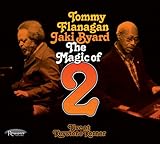
Tommy Flanagan Jaki Byard The Magic 2 Live at Keystone Korner (Resonance Records)
In 1982, jazz pianists Tommy Flanagan and Jaki Byard came together for a one night duo piano show at a happening jazz spot in San Francisco called Keystone Korner. If nothing else bringing the two jazz luminaries together proved the person who booked talent for the club wasn’t afraid to think outside the box. It was an odd pairing no doubt. Flanagan’s and Byard’s styles are different than night and day. Flanagan was an elegant conservative who performed with the likes of Ella Fitzgerald and Sonny Rollins. 

Byard was a gunslinger versed in every kind of African-American music and he partnered during his career with many of the kings of free-jazz such as Charles Mingus, Eric Dolphy and Booker Ervin. So on paper pairing the two could’ve been a disaster. But the booker at Keystone Korner banking on this pairing to be one of the most exciting in the history of jazz worked out. On this album “Tommy Flanagan Jaki Byard The Magic of 2 Live at Keystone Korner, was recorded live, and will be released for the first time on 

April 9th by Resonance Records, the pianists took some old standards out of storage and on a road trip. The album, which comes with a 24 page booklet, opens with “Scrapple from the Apple,” a Charlie Parker number. Then Flanagan and Byard stop by Ellington’s and Tad Dameron’s place before ending their road trip with Miles Davis’ “The Theme”. The album has 12 cuts. On six of them the pianists play together. Then they perform solo on three cuts each. Soloing their individuality shines. As a duo, their different styles never clash.

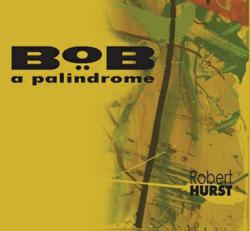
Robert Hurst Bob a palindrome (Bebob Music)
“Bob a palindrome” is jazz bassist Robert Hurst’s sixth studio recording and his best yet. That’s a big deal. In 2010, Hurst released two masterworks “Bob Ya Head” and “Unrehursted Volume 2”. Honestly, no one was banking on another major work from Hurst for a while. Those excellent contributions to the jazz cannon gave Hurst immunity. But Hurst isn’t the brand of jazz musician who depends on his laurels. 

The core of Hurst’s band on “Bob a palindrome” is the pianist Robert Glasper and the drummer Jeff “Tain” Watts who have proven over time to be Hurst’s kindred comrades. There’re a handful of special guests here trumpeter Marcus Belgrave and saxophonists Branford Marsalis and Bennie Maupin. It’s impossible to do anything short of astounding with that kind of firepower. Hurst understands that and he got a lot of mileage from the band. Hurst isn’t just the best jazz bassist on earth right now. 

Hurst is also a killer composer. Something he’s never received credit for. On this album more than his others, Hurst’s composing is the focal point. All 10 cuts here are award worthy, but the best is the three suite movement “Middle Passage Suite: Part I For Those of Us Who Made It, Part II For Those of Us Who Didn’t Make it, Part III For Those of Us Still Here. The last movement is 12 plus minutes of prime choice swing.

John Medeski A Different Time ( OKeh)
There’re two sides to jazz pianist John Medeski the groove monger who’s the heart and soul of the ball-busting jazz trio Medeski, Martin, and Woods, and there's the deep thinking jazz musician which his fans rarely see. The latter is what Medeski’s fans will get when his first solo piano album “A Different Time” drops April 9th on Okeh, a division of Sony Music. 

"A Different Time," is an outstanding compared to other solo jazz piano albums out there. It appears Medeski designed “A Different Time” to showcase his mad skills, which honestly has never been in question. Medeski is a groove driven swinger at heart. This album of originals is a deep thinker’s odyssey. The funny thing is making this kind of music seems natural to Medeski as breathing and as sleeping.