Wednesday, January 23, 2013

FROM CASS CORRIDOR TO THE WORLD CONCERT LACKED CONTEXT

Pianist Geri Allen

The biggest shortcoming of the From Cass Corridor to the World: A Tribute to Detroit’s Musical Golden Years concert Monday evening at Hill Auditorium in Ann Arbor Michigan was pianist Geri Allen, its musical director, never explained the importance of Cass Corridor as it related to Detroit’s vast jazz history. Not one word from any of the special guests about how the Northwest side neighborhood—once a haven for drugs and for prostitution—impacted Detroit’ jazz community.

From the start, Allen informed the packed auditorium there’d be little talking. There was too much music to get to. The concert went on for nearly three plus hours, and although it brimmed with highlights, I was full midway. The star-studded get together, at times, felt as if Allen crammed four concerts into one. Detroit jazz musicians know how to put on an elaborate production, but they haven’t mastered editing. That’s what the concert needed desperately.

The first set opened with a salute to Dr. Martin Luther King. Professor George Shirley read King’s “On the Importance of Jazz,” speech that King gave at the Berlin Jazz Festival. It wasn’t one of his best. Besides, I founded it unbelievable King was a jazz fan.

As Shirley read King’s words, I tried to picture him checking out some Charlie Parker albums in his study late at night after Coretta and the kids were sleep. I had King pegged as a gospel fan. I never imagined he was into Dexter Gordon and Ornette Coleman or King had a serious jazz record collection.

After Shirley finished the speech, he joined the University of Michigan’s Day Choir and they sang “Lift Every Voice and Sing,” one of King’s favorite spirituals. Then singers Shahida Nurullah, Joan Belgrave, Ursula Walker and Naima Shamboroguer joined the choir for a selection. The singers performed the horn parts of "I Have A Dream" from pianist Herbie Hancock's last album for Blue Note Records "The Prisoner".

After the singers left the stage, a tribute to saxophonist Yusef Lateef and drummer Roy Brooks followed, which was the concert’s first highlight the drum battle between Karriem Riggins and Ali Jackson. The battle perked up the audience.

The most endearing moment of the set was the nod to trumpeter Marcus Belgrave. He's been ill lately. But he looked and sounded sharp. He was genuinely surprised when the University of Michigan presented him with the King, Chavez-Parks Visiting Professor Award.

The second half of the concert offered the most highlights, starting with a fun tribute to jazz bassist Ron Carter. Bassists Robert Hurst, Marion Hayden, and Ralphe Armstrong showed out. Next, was a kick-butt shout out to trombonist Curtis Fuller and pianist Harold McKinney.

McKinney's daughter, jazz drummer Gayelynn, had the honor of representing her dad. Vincent Chandler, who’s become a master trombonist, gave Fuller proper due.

It took saxophonist James Carter and organist Gerard Gibbs to hit the audience in their souls with a take of “Precious Lord” that would’ve given Jesus goose bumps. Henceforth, the concert turned into a revival. Joan Belgrave followed Carter with a beautiful gospel selection. She damn near caught the Holy Spirit on stage. 

If that wasn’t enough, the Motown Legends Gospel Choir took the concert to the streets. I never imagined some of the people who voted for Rich Snyder could catch the Holy Spirit, but the choir had everybody worked up.

The concert should’ve ended there. But there’re three rushed performances one by the original Vandellas, another by the Contours, and the last, a tribute to hip hop icon J Dilla, by a rapper named Invincible. By this point, the concert felt as if Allen was determined to let every performer get a turn at bat. Allen never put the Cass Corridor angle into context, which is forgivable because the music was so damn good, and  Allen had so much of it to navigate. But it would’ve been nice to have heard from several of the musicians about what Cass Corridor  meant to them.   

Saturday, January 19, 2013

AARON DIEHL FINALLY HAS A RELEASE DATE

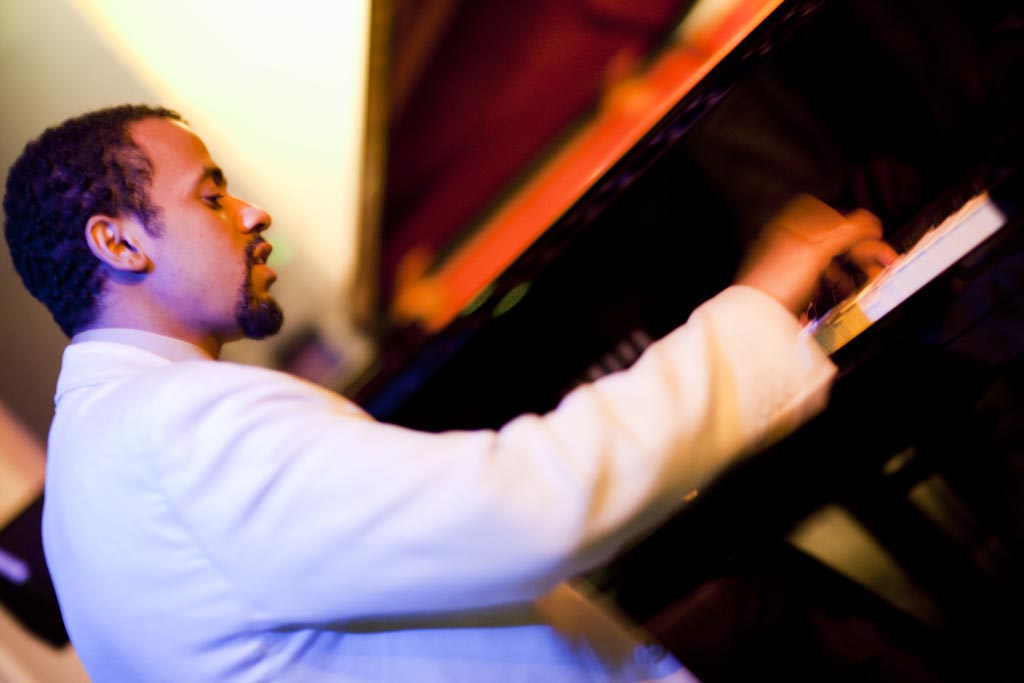
Pianist Aaron Diehl
 Mack Avenue Records has finally committed to a street date for “The Bespoke Man’s Narrative,” jazz pianist Aaron Diehl’s much anticipated studio debut. Diehl signed with Mack Avenue in 2011 after winning the Cole Porter Fellowship in Jazz Competition of the American Pianist Association.

Mack Avenue Records, a Detroit based jazz  record company, founded in 1999 has signed many leading jazz musicians such as Kenny Garrett, Christian McBride, Kevin Eubanks, Sean Jones and Gerald Wilson.

"The Bespoke Man's Narrative" isn't Diehl's first outing as a session leader. He has two live albums on the market “Live at the Players,” and “Live at Caramoor,” He’s the kind of jazz pianist who can switch from sophisticated to grits and gravy easily and who can play any form of jazz adeptly as well as gospel and the blues. 


“The Bespoke Man’s Narrative,” available nationwide March 19th is Diehl's first big label album. Diehl’s fans are hunger for it. Mack Avenue scheduled the album for February 2012 but they delayed i, wanting it to correspond with a national tour. 


On the album, Diehl jams on originals such as “Generation” and “Blue Nude” and a handful of standards “Bess, You is My Woman Now” and “Single Petal of a Rose” with his smoking band Warren Wolf, Dave Wong, and Rodney Green, which is one of the  tightest bands working.

Monday, January 7, 2013

10 KILLER CONCERTS OF 2012 IN DETRPOIT


Charles Lloyd
The Dave Holland Big Band (Michigan Theater) 
Big band swim at its very best. Holland's big band proved on this night it could swing the English Channel without coming up for air.

The Charles Lloyd Quartet (Michigan Theater) Impossible to put on a shitty performance when Lloyd was flanked by the incredible pianist Jason Moran. The night was full of highlights.

Mike Jellick The Nutcracker Suite (Detroit Institute of the Arts) A colossal undertaking for Detroit's hottest jazz pianist and bandleader. He took this reworking of the classic on the dry-run this time last year. After many returns to the drawing board, Jellick finally worked out all the kinks. Before the night was in the can, the performance received three ovations.

Cassandra Wilson (Orchestra Hall) Wilson is still the baddest jazz vocalists in the game. This was a memorable outing although Wilson was forced to take an intermission, and doing so upset the groove the band swung hard to establish. At any rate, Wilson made the best of it.

Freddy Cole (The Dirty Dog Jazz Café) The epitome of an old-school balladeer and storyteller. Cole fancies love songs from the American songbook. And he rendered them as originally conceived. I could listen to Cole sing for breakfast, for lunch, and for dinner. 

Celebrating Women in Jazz (Max Fisher) This should be an annual concert. There were beautiful performances by pianist Ellen Rowe, bassist Marion Hayden, vocalists Joan Belgrave, Ursula Walker, and drummer Gayelynn McKinney.

Yusef Lateef Tribute (St. Matthew’s Church) One of jazz's most prolific saxophonist honored in his home town. The performance of his music and the recitations of his literary works made the 92-year-old jazz giant weep.

The Mack Avenue Super Band (The Detroit Jazz Festival) Mack Avenue Records is the hottest jazz record company around and some of the star jazz musicians Tia Fuller, Sean Jones, Rodney Whitaker, and Aaron Diehl made up the super band, which worked on paper and more so in reality.  

The Aaron Diehl Quintet (The Dirty Dog Jazz Café’) The Detroit Tigers were in the throes of a run for the World Series, so the turn out for Diehl's concert was small, but the pianist didn't allow that to stop him from putting on an excellent concert. 

Tony Lustig (Cadieux Café) Lustig has found his voice on the baritone saxophone, and he's been working steadily going on three years now in New York. Lustig's heart is still in Detroit. His annual holiday show at the Cadieux Cafe' has become a major concert. The cafe' was packed and Lustig's band which included drummer Jesse Kramer kept spirits high with his modern spin on some jazz classics. 

Wednesday, December 26, 2012

TONY LUSTIG HIT BIG AGAIN AT ANNUAL HOLIDAY CONCERT

Saxophonist Tony Lustig

The past three years, the baritone saxophone player Tony Lustig has put on a holiday show at the Cadieux Café on Detroit’s east side. The show is jammed every year. Lustig—a Detroiter who now lives in New York and who’s made a name there—knows how to entertain. He kept the crowd cheery for three sets with good swing music, and a handful of Christmas classics.

In 2009, Lustig moved to New York. He’s played with some decorated jazz big bands the Jazz at Lincoln Center Orchestra, Arturo O’Farrill and the Afro-Latin Jazz Orchestra and the Christian McBride Big Band. Being hooked up with those big named bands may explain how Lustig has developed such a unique voice on the baritone sax so fast.

This year, for the annual show, Lustig hired three of Detroit’s top sidemen drummer Jesse Kramer, bass player Jeff Pedraz, and piano player Mike Jellick. Lustig’s sets included some familiar jazz gems such as “My Shining Hour,” “Strollin’,” “Swingin’ at the Haven” and “Hard Times”. Plus, Lustig called some new cuts from his debut album “Taking Flight” due out next year.

Lustig is a baritone player who climbed the ranks the old-fashion way. During his early years, Lustig studied with jazz bass player and educator Rodney Whitaker at Detroit Symphony Orchestra’s Civic Jazz program. (I first met Lustig there. I was assigned to write about the program for the weekly newspaper the Metrotimes. Lustig was one of the students I was drawn to. He was a mature teen, and I felt Lustig would be a special player someday).

After his run with Civic Jazz, Lustig joined Whitaker at Michigan State University. Whitaker runs the jazz studies program there, and Lustig was a prize recruit. A big part of Lustig’s seasoning was studying the great baritone sax players Gerry Mulligan, and Pepper Adams.

Lustig can make the baritone sound like a tenor sax, which he told me after the first set he’s been trying to perfect for some time now. Well Sunday night’s show proved Lustig has it down pat.

Being backed by Kramer, Pedraz, and Jellick made it all the more real. Lustig blew every note with a keen sense of tailoring. His working in big bands has imbued the value of teamwork. Lustig is no ham. He shared the spotlight with his sidemen.

They showed their thanks playing outstanding solos, particularly Pedraz who style called to mind the great Cameron Brown. The first-call drummer Jesse Kramer isn’t big on being out front. But when Kramer took a few solos, they were well-developed like a pro bodybuilder's calf muscles..

Jellick, a bandleader who runs the Wednesday night session at the Northern Lights in mid-town Detroit, never showed any signs of battle fatigue. 

Friday, Jellick premiered his arrangement of the “The Nutcracker Suite” at the Detroit Institute of the Arts. Saturday, evening he played it again at Cliff Bell’s. Reasons enough to give his A game the night off. If Jellick was fatigued, somehow he found the resolve to recharge his A game. Jellick was by Lustig's side on every number. 

 Lustig has put in hard work, and this annual show, which felt like a community gathering, in three years has become a major happening.

Saturday, December 22, 2012

A NOTE TO TCHAIKOVSKY REGARDING MIKE JELLICK’S INTERPERTATION OF THE 'NUTCRACKER SUITE'

Pianist Mike Jellick

Dear Mr. Tchaikovsky,
I am Charles L. Latimer. I'm a jazz reporter and jazz blogger. I want to take a minute of your time to tell you about an outstanding show I caught Friday night at the Detroit Institute of the Arts. The jazz piano player and arranger Mike Jellick put on the show. Jellick is, 32, and in the past two years has become the top jazz piano player in the state of Michigan.

Funny thing, Mr. Tchaikovsky, is five years ago Jellick couldn’t play worth a damn. He had a hard time making a living. Eventually, Jellick became frustrated because he couldn’t get steady work. So he moved to Chicago. Jellick always showed promise. Plus, he had a colorful and a fertile  imagination. But he lacked the chops to pull off all the slick musical ideas swimming in his head. Being in Chicago did him a world of good.

In Chicago, Jellick practiced for two years. He soaked up Chicago’s jazz scene. Then he returned to Detroit anew. It didn’t take long for him to become a first-call commodity. Friday night, Jellick and his quintet—drummer Jesse Kramer, bass player Miles Brown, saxophone player Marcus Elliot, and singer Kira Frabotta and special guest trumpeter Chris Johnson--presented an ambitious work that took Jellick two years to perfect.

Jellick reworked your yuletide masterpiece “The Nutcracker Suite”. Not that it needed reworking. Jellick wanted to put his spin on it, and boy did he ever. Given the positive response from the standing-room-only crowd Jellick’s reworking of the suite was a hit. What did Jellick do to your work you wonder.

Jellick took “The Nutcracker Suite” apart note by note, applied a few new coats of paint on some notes, and added a number of tempo and mood changes. He retooled the suite like an auto mechanic retools an engine of a priceless car. Jellick didn’t borrow from any of the other arrangers who rearranged “The Nutcracker Suite,” including the great Duke Ellington.

Borrowing from others wouldn’t have been a challenge for Jellick. Jellick’s take was solely the product of his imagination. Of course, the show wouldn’t have been a hit without the participation of Jellick’s world-class band.

Miles Brown was sweet. He walked the bass all night long like one of Santa’s reindeers. Kira Frabotta turned her voice into an instrument. Marcus Elliot proved he’s one of the leading tenor players of his generation. He’s a youngster who’s invested plenty man-hours studying the greats of the tenor sax. 

Jesse Kramer was a textbook example of how tasteful a drummer should be. He knows the chief task of a jazz drummer is powering a band, and Chris Johnson fit like candles on a kid’s birthday cake.

Jellick was the consummate leader. Mr. Tchaikovsky, I bet a month’s pay you would’ve loved his playing. And you might’ve been a tad jealous. Damn, I wish I had played the section of the suite that way you might’ve said to yourself.

The best part of the show was Jellick’s solo version of “A Christmas Song,” which received the first of three ovations. Mr. Tchaikovsky, I don’t have enough fingers and toes to count the number of people I overheard say Jellick’s show was the best they attended this year. Jellick is performing the suite again tonight at Cliff Bell's in downtown Detroit. If you aren't doing anything you should check it out.

Best always,
Charles 


Tuesday, December 18, 2012

TOP 10 JAZZ ALBUMS OF 2012


1.)         Don Byron “Love, Peace, And Soul (Savoy Jazz)
Don Byron always thinks outside the box. On this album, Byron performed some deep research into the work of gospel legend Thomas A. Dorsey. Once Byron selected the cuts for this album he picked vocalist DK Dyson to pour her gorgeous voice over each cut. The result is the greatest gospel jazz album in recent memory.

2.)         Ravi Coltrane “Spirit Fiction” (Blue Note Records)
Coltrane’s dad saxophone God John Coltrane would be proud of Ravi’s latest album. Ravi has an impressive discography to date, but this album, his first for Blue Note, is Ravi’s opus. Every component works from hiring Joe Lovano to produce it to having pianist Geri Allen to bless it. Ravi is not a natural swinger. His hallmark is story telling.

3.)         Branford Marsalis “Four MF’s Playin Tunes (Marsalis Music)
If nothing else, Marsalis can come up with a catchy title for an album. In the past, there’s been titles such as “Crazy People Music” and “I Heard You Twice the First Time”. Marsalis is by all accounts the leading saxophonist of today, and since opening Marsalis Music, he’s put out one outstanding album after the next. “Four Motherfuckers Playing Tunes” is Marsalis’ finest album for the label thus far. Plus, the album is the proper outlet to showcase the newest member of Marsalis’ band drummer Justin Faulkner—who took Jeff “Tain” Watts’ spot. Faulkner proves to be a suitable replacement, and it’s fun listening to the other longstanding band-mates break in the youngster.

4.)         Eric Alexander & Vincent Herring “Friendly Fire” (High Note) This album recorded live and Smoke is the second blowing session for two of jazz’s upper tier saxophonists, and the high level of swing is on par with the classic blowing sessions Eddie “lockjaw” Davis and Johnny Griffin made. Be careful with this album. It will burn up your ear drums.

5.)         Cyrus Chestnut “The Cyrus Chestnut Quartet” (WJ3) Chestnut is the kind of pianist who can let his inner swinger go at will. That’s particularly true when he’s leading his trio. When playing with his quartet, Cyrus likes to give his sidemen the lion share of the spotlight. On this album, Chestnut’s best in years, he ask saxophonist Stacy Dillard to shoulder most of the workload, and Dillard does so magnificently.

       6.) The Cookers “Believe” (Motema)
         Billy Harper, Eddie Henderson, David Weiss, Craig Handy, George Cables, Cecil McBee, and Billy Hart. It's not difficult at all to make a smoking hot jazz album when those all-star jazz musicians are in the same band. Of course, this project could’ve turned into an ego fest. There’s some strong personalities in the band, but each swinger understood this all-star project wasn’t about individuality. The project worked on paper and it worked in reality.

7.)         JD Allen “The Matador and The Bull (Savant) Saxophonist JD Allen is a thinking man’s saxophonist as evident on all 12 cuts on his latest album. Like Branford Marsalis, there’s substance behind every note that Allen plays. He never swings for the sake of swinging.

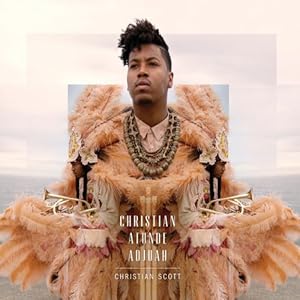
8.)         Christian Scott “Christian Atunde Adjuah” (Concord Records) Early in his career it was obvious Christian Scott wasn’t going to be happy as a run-of-the-mill jazz trumpeter. So Scott—who recently changed his name to Atunde Adjuah—has been experimenting since day one, and finally all his hard work has come to fruition with this remarkable double album, a bulletproof representation that Scott has come up with a winning formula.

9.)         Orrin Evans “Flip the Script (Posi-tone) For years now, pianist Orrin Evans has been quietly making wonderful trio jazz albums, but Evans for whatever reason hasn’t garnered the press or praise given his peers. However, Evans carries on unfazed. Here Evan plays blues, pop, and a lot of bop beautifully.
        
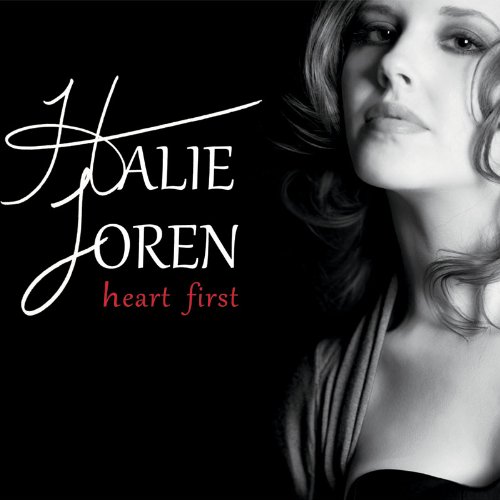
        10.) Halie Loren “heart first” (Justin Time) She is not a household name yet, but who cares this woman can sing. The cut “Waiting in Vain” will make an attack dog cry. Loren loaded up this album with  14 songs, which is a good thing because the time you spend with her delicious voice never feels rushed.

Monday, December 10, 2012

DIANNE REEVES CLOSED 2012 TOUR IN HOMETOWN

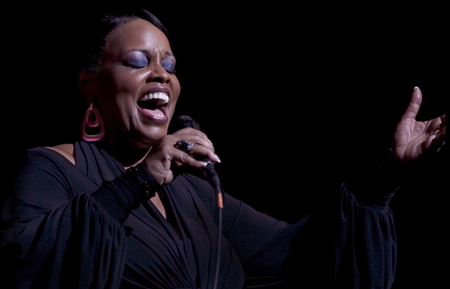
Dianne Reeves
Guitarist/songwriter Raul Midon was billed as a special guest at the second concert of the University Music Society’s Jazz Series Saturday evening at Hill Auditorium in Ann Arbor, MI. Midon was hired to heat up the stage for jazz singer Dianne Reeves. But Midon pimped the stage as if it was his bitch, and the audience ate it up. Midon, a native of New Mexico who’s been blind since birth has five albums on the market, and he’s been touring with Reeves.

 Midon was escorted on stage and put in front of a mic where he shocked the audience for twenty plus minutes, working out on cuts from his 2010 album “Synthesis”. Midon told the packed auditorium after the opening number there wasn’t any technology on the stage just human technology. Then Midon played the guitar and bongos at the same time, and made his voice sound like a  trumpet. Midon has a good voice, and he can switch from falsetto to baritone. 

I gathered it was the first time most of the audience had experienced Midon. He set the bar high for Reeves. Reeves, one of the top jazz singers around, is having a hall of fame career. But, her live shows are hit or miss. Reeves like to end her tours in her hometown. I’ve caught three, and sometimes she seemed bushed. She’s never really gone for broke. 

Saturday, Reeves’ gorgeous voice was in top condition, but her set didn't have any memorable highlights. Reeves played it safe singing mostly well-known songs such as “Stormy Weather,” and “Misty”. And there was a lot of scatting which Reeves is a pro at. In fact, no Dianne Reeves show would be complete without her scatting up a storm. 

Reeves has one of the toughest bands on earth piano player Peter Martin, guitarist Romero Lubambo, bass player Reginald Veal, and drummer Terreon Gully. And she got good use from them. When Martin and Reeves did a duet on “Misty,” I was reminded of the truism that a jazz singer is only as good as her piano player. 

Martin is a complete package, and I wondered if Reeves could get along without him. Reeves set wasn’t packed with highlights, and obviously she didn’t put a lot of thought into the set list. Honestly, people attend her shows to hear one of the top jazz voices around not to see a spectacle.