Wednesday, June 29, 2011

STRUTTING THEIR STUFF

Mirth and Melancholy is Branford Marsalis’ fourth duet album. Branford made one with his father, Ellis, and two with singer and piano player Harry Connick Jr. This time around, Branford teams up with his longtime bandmate Joey Calderazzo, who in 1998 replaced Branford’s regular piano player Kenny Kirkland. Joey found his voice in Branford’s band, and Joey has recorded two albums on Branford’s label Marsalis Music.

Mirth and Melancholy, which Marsalis Music released on June 7, is the best of Branford’s duet albums. The music on the album is what the title proclaims. There’s two mirthful songs the opener One Way and the closer Bri’s Dance. Branford and Joel have a field day improvising on those songs. 

Mirth and Melancholy is more melancholic, but in a good and interesting way. It also has a classical music feel. You will be taken by Branford and Joey’s virtuosity. Branford always makes great albums, and his musical achievements are known. But, his cerebral way of improvising gets overlooked. Branford’s musical imagination is on par with Sonny Rollins.

Back to Joey. In Branford’s band, Joey’s chief responsibility is backing Branford, which is a big undertaking because Branford is a note monger. Count the notes Branford plays on Face on the Barroom Floor, and Precious. In a one on one setting, Joey seems less stressed.

That’s clear on The Bard Lachrymose and Endymion. Joey isn’t face with the everyday chores of a jazz piano player. Joey roves and explores freely. Mirth and Melancholy shows two virtuoso jazz musicians making each other look good.

Sunday, June 26, 2011

NEW LION

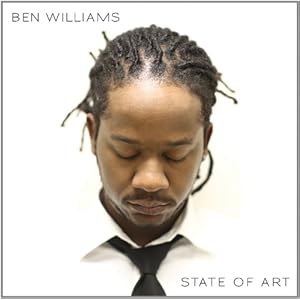
After graduating from Michigan State University and winning the 2009 Thelonious Monk International Competition for Double Bass, Ben William became sought after, playing on two important albums for Concord Records Stefon Harris’s Urbanus and Jacky Terrasson’s Push. On June 28, William’s debut album State of Art will go on sale nationwide.

State of Art is Williams’s first go round as a leader, and he takes some risks. Williams successfully blends hip-hop, R&B, and classical music. That’s a lot of calories to consume on a debut.

William’s staff saxophone player Marcus Strickland and piano player Gerald Clayton are bandleaders, and they have more work experience. Neither has any issue working for an inexperienced boss.

Clayton soars like a hang glider on Mr. Dynamite. Strickland has a tone fattier than cheesecake on Moontrane and This Don’t Exist. Williams plays with a puppy love kind of charm and innocence on Little Suzie Intro.

How is Williams as the boss? Williams is the kind of boss every dedicated employee wants. Williams shows complete faith in staff. State of Art is as much about them as it’s about Williams.

Lee Morgan Story is the only stain on State of Art. Rapper John Robinson raps about Morgan’s life story while trumpeter Christian Scott apes Morgan’s style. A rapper reciting Morgan’s life story seems like a novel concept on paper. On State of Art, the song seems misplaced.

At Michigan State University, Williams was exposed to jazz bass player Rodney Whitaker. Whitaker runs the university’s jazz studies program. Whitaker’s gentlemanly manner of playing the bass rubbed off on Williams.

Saturday, June 25, 2011

AMY WINEHOUSE'S DAD SINGS, TOO

Mitch Winehouse is pop scarlet Amy Winehouse’s father. Until recently, he was a cab driver in the UK and a closet jazz singer. In March, Winehouse’s debut album Rush of Love went on sell. Winehouse is 60-year-old. He never felt it was too late in life to start a singing career. Amy used her star power to help her Father get going.

For Rush of Love, Winehouse choose songs from the American songbook such as Please be Kind, Tell Me, I Apologize and April in Paris. Winehouse decided to go big, So he used a big band on all but one song, Tell Me.

 Winehouse is a hopeless romantic with a voice that’s smooth like body lotion. On the tearjerker Tell Me, he gives us a taste of how sweet he sounds back by only a rhythm section.

Maybe Winehouse will only use a rhythm section on his next album. Anyway, Rush of Love is a wonderful debut. And Winehouse sounds as if he had a swell time making it.

Friday, June 24, 2011

CELEBRATING A CRITIC

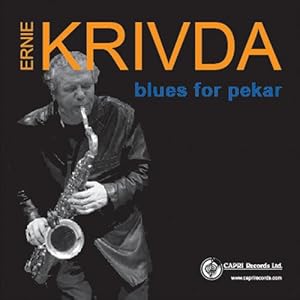
"Ernie Krivda is one of the best jazz tenor sax men in the world,” the late jazz critic Harvey Pekar once stated. If you require proof Krivda deserves praise, buy Krivda’s new album Blues for Pekar. Pekar and Krivda were friends. Blues for Pekar is Krivda’s second album in two years. Last year, Cimpol released Ernie Krivda & the Detroit Connection Live at the Dirty Dog.

Save for adding Detroit bass player Marion Hayden, Krivda uses the rhythm section that played on Live at the Dirty Dog piano player Claude Black, and drummer Renell Gonsalves. There’re cameos from trumpeters Sean Jones, and Dominick Farinacci. Blues for Pekar is the kind of straightforward bop album that Krivda loves making and his admirers expect. 

The album opens with The End of a Love Affair. Wear a hardhat listening to this song. Krivda blows forcefully enough to demolish an abandon warehouse. On the ballad More Than You Know, the notes drip off Krivda’s tenor like tears off an infant’s cheeks. At the end of the ballad, Krivda plays a catchy cadenza.

Krivda is a generous bandleader. He shares the wealth with his bandmates, particularly Claude Black. Black and Krivda have been together for decades. They’re comfortable like an old married couple.

Black—a down home bebop piano player a la Duke Jordan and Walter Bishop Jr —presence resonates. On Valse Hot and Fried Bananas, Black takes the tunes on a 5k run. And Jones and Krivda trade measures like hot gossip. Farinacci, a trumpeter with  journeyman’s chops,  digs into the song like a landscaper.

Pekar was a hard-ass and he never minced words. Not many jazz musicians would dedicate an album to a jazz critic. Check around, Krivda might be the only one. Harvey Pekar and Krivda were close. Blue for Pekar is a celebration of their friendship.

Thursday, June 23, 2011

THREE OF A KIND


Stefon Harris, David Sanchez, and Christian Scott have a few things in common. They’re Grammy nominated jazz musicians. (Sanchez won a Grammy in 2005 for best Latin Jazz Album.) They’re signed to Concord Records, and are the faces of  Concord’s jazz division. They’re successful bandleaders with a string of good jazz albums on the market.

Scott is younger than Harris and Sanchez, and presently Scott is more of a daredevil. Harris and Scott are time tested. Proving themselves is no longer a priority. I heard Scott for the first time in Detroit with alto saxophone player Donald Harrison’s band. Scott was only 17-year-old at the time. Scott had that rugged and piecing sound New Orleans’ trumpet players have. Scott had a lot of heart as well, and he seemed comfortable among musicians twice his age.

Harris and Sanchez hit the jazz scene in the mid-90’s when major record companies such as Atlantic, Blue Note, Criss Cross, Evidence, and PolyGram were giving young and promising jazz musicians such as Mark Turner, Christian McBride, Mark Shim, Cyrus Chestnut, and Anthony Wonsey sweet recording deals. Doing so upset many veteran jazz musicians because they couldn’t get the same although they had a fan base.

By 2000, those record companies downsized, and many of those promising jazz musicians lost their deals. Harris and Sanchez survived the downturn, and have successful recording careers.

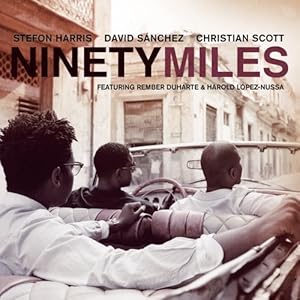
On the new album Ninety Miles, which Concord Records made public on June 21, Harris, Sanchez and Scott, combine their work experience, resulting in one of the finest jazz album I’ve come across this year. Harris, Sanchez and Scott made Ninety Miles in Havana Cuba, which explains the album’s Cuban favor.

Ninety Miles starts out running and never makes a pit stop. Harris, Sanchez, and Scott brought to the session a swinger's mentality, and their distinct styles mesh.

The album has a bonus tracks, and a DVD that gives insight into the album’s creation. Including a DVD suggests Concord Records knew bringing Harris, Sanchez, and Scott together was epic. And their fans would enjoy a sneak peek of the making of Ninety Miles.

As a leader, Scott has been off course, preoccupied with fusing other forms of music with jazz. Scott hasn’t put out a red-blooded jazz album yet, leaving some jazz people wondering if Scott will ever return to his jazz roots. The wondering can stop because Scott is back to his jazz roots on Ninety Miles, blowing with heart and enthusiasm on City Sunrise, Black Action Hero, and Brown Belle Blues.

Harris and Sanchez are brilliant. Sanchez slow dances with his tenor on The Forgotten Ones. Harris probably has to rub down his vibraphone because of the workout Harris subjects it to on Brown Belle Blues and on La Fiesta Va. If Ninety Miles is hits--which undoubtedly the album will be--Concord Records should encourage Harris, Sanchez, and Scott to record together again.

Monday, June 20, 2011

BORN TO SING

For 40 years ago, jazz singer Ed Reed was a self-loathing heroin addict. Reed served four stints in San Quentin State Prison for drug related crimes. Strangely, in prison, Reed developed his chops, performing with other musically inclined criminals in a 17-piece ensemble called the Warden’s Band. Reed said jazz great alto saxophonist Art Pepper was in the band. “At one point, Art played on all the songs I sung in that band,” Reed recalled.

Reed grew up in California. Reed began singing as a kid, and he dreamed of stardom as a jazz singer. Reed became an addict in the Army. The addiction sidetracked his dream.

In 1986,  Reed had an encounter with a smelly fat man at a bus stop that compelled Reed to get clean. Reed has been clean now for 25 years and he works with addicts and their families at the Kaiser-Parmanente’s Chemical Dependency Recovery Program in Vallejo, California.

At 82-year-old, Reed is vibrant. Reed is also candid. Reed is an old-school jazz singer and balladeer a la Bill Henderson and Johnny Hartman. Reed’s voice has a literary quality, built for songs that convey stories. Reed put out two popular jazz albums Ed Reed Sings Love Stories and The Song is You. 

The father of jazz journalism, Nat Hentoff, has praised Reed. In 2008 and in 2009, Reed placed fourth in DownBeat magazine prestigious critic’s poll for Male Vocals, Rising Star. Tuesday, Blue Shorts Records makes public Reed’s new album Born to be Blue.

On June 15, I Dig Jazz had a telephone interview with Reed. Reed discussed starting his recording career at 78, kicking heroin, and why Born to be Blue is his crowning achievement.

Why did you start your music career at age 78?

Ed Reed: You know, I spent so much time being crazy. I was just interested in my recovery. I wanted to know what makes people drink and do drugs until they are dead. That's where my interest was, and still is.

Singing was like dessert. I had always sang, but I didn't take it seriously until I went to Jazz Camp West and Peck Allmond [ jazz trumpeter and composer]  asked me where my records were. He said you got to record and he hooked me up with Bud Spangler, and the rest is history.

When you were using, were you performing?

Reed: If I came across some money to tide me over, I would sing occasionally, but when I was an addict singing wasn't that important to me. I didn't believe that I had anything to offer the world musically.

Born to be Blue is a blues album... 

Reed: There's only one blues song on it, but the other songs are stories of sadness, confusion, hope, and being unable to talk that sort of stuff. If you look at the picture on the cover, I was like 5-year-old, and I was really unhappy, and it made me realize when I looked at that picture that was the way I started out being unhappy, and out of shape.

I talk about that in my classes. That community and family shapes character, and we all have the blues. We should acknowledge the blues so we can free ourselves of it, and live in the moment. That's where the concept for the album came from.


Jazz vocalist Ed Reed

Was there a jazz band in San Quentin?

Reed: San Quentin had a band that performed for the Warden Show. The Warden Show was a tour the warden set up to show professional law enforcement people about what the penitentiary was like. The warden had a tour twice a month, and there would be a dinner. The band played at the dinners.

 Art Pepper was in that band.

Reed: Art Pepper played on every tune that I sang. We had some great players. That band was a trip.

How much time did you serve?

Reed:  I had four stints, from 1951 to 1953. The second time I went back from 1955 to 1958. Then I went backs from 1960 to 1963. Then I went back 1964 to 1966. It was like living life on an installment plan.

You had plenty time to hone your craft.

Reed: I did that and I worked in the library. I was trying to find out what was wrong with me.

What did you discover?

Reed: You know, I don't think anything was really wrong with me except by ignorance. I didn't know how to take care of myself. Most people don't. By that I mean, we don't understand what other people do is because of them not because of us. And what we do is because of us not others. To understand that took me a long time. The discomfort of the belief system that somebody did something to make me mad is the kind of stuff that creates addiction.

When did you hit rock bottom?

Reed: I was sitting on a bus bench and I was brokenhearted. I smelled something like a dead animal. And it was this big guy who looked like he was 400 pounds. He smelled like he was dead. He was coming to sit on the bench, and I told him, 'Man you can't sit here. This is my bench'.

I heard that and I said here I am claiming a bus bench. If this was the only thing I had in life was to claim a bus bench, I needed to do something to change my life. But, I didn't know what to do. Back then, I didn't believe in God. So I went to an AA meeting. It was really painful to know I was claiming a bus bench. That was in 1986.

How does Born to be Blue compare to Ed Reed Sings Love Stories and The Song Is You?

Reed: The first two albums all I did was sing the tunes. I didn't have much to say about how the tunes were going to be played, and who was going to play on them. And there were time constraints. This time around, I'm the co-producer and I had a lot of say about what we're going to play.

Which tunes are your favorites?

Reed: I really like Inside a Silent Tear and Abbey Lincoln's Throw it Away. That song it about letting the stuff go that bends us out of shape.

When you decided to make this album, what kind of songs, did you want?

Reed: I wanted songs that everybody wasn't singing. The songs needed to be beautiful to me. Harmonically, they had to say something I wanted to say. I wanted to do the songs my way, and they had to say something about dreaming and being happy.

Do you listen to your albums often?

Reed: I have a hard time listening to my recordings...

That's odd. you have such a wonderful voice.

Reed: Every time I listen to my albums, I find something that I should've done or should've changed.

Were you pleased with the outcome of the other albums?

Reed: No. They got a lot of attention, but they left a lot to be desired. I never got to do the tunes the way I want to. I wanted to try the tunes on with the band. I never got a chance to do that. I didn't get to sing with the band. They laid down the tracks and I recorded over them.

You’ve come full circle . Are you happy?.

Reed: I was thinking about my addiction the other day. Man, what a miserable human being I was. But now I have a good thing going. I have somebody that loves me, and I love her. You know we've been married 43 years now. These records wouldn't be out with out her.

Saturday, June 18, 2011

PREACHING AT THE DIA

Salim Washington (photo by Ricardo Thomas)
Before saxophonist Salim Washington began his set Friday night at the Detroit Institute of Arts, he gave 15-year-old tenor sax player Steve Grady some pointers. Grady was at the concert with his parents and his sax teacher JuJu Johnson. Three tunes into the set, Washington put Grady on the spot, inviting him to sit-in. 

Grady wasn’t scared. Grady’s tone and phrasing revealed he's spent quality time listening to Hank Mobley’s albums. Grady could play rhythm changes. After Grady soloed, the crowd erupted. Washington told them when he was a teenager his idol saxophonist Pharoah Sanders put him on the spot on many occasions.

Washington played two stunning sets. The first set Washington called familiar free-jazz tunes such as Frank Lacy’s Aquarius Rising and Andrew Hill’s Symmetry. Washington hired Detroiter's pianist Pam Wise, drummer Djallo Djekete, and bassist Marion Hayden. 

Friday was the first time Hayden had played publicly with Washington, but you couldn’t tell. They clicked immediately. Hayden is best backing saxophonists. Hayden did some of her best work with the late Donald Walden. Hayden has never demanded much solo time. All night, Washington encouraged Hayden to stretch out.

Hayden was featured on You Can Fly, a song Washington wrote for his sister. Hayden’s intro was dazzling. On Is That Jazz, Djekete was powerful. Djekete is a blue-collar jazz drummer. He always shows up prepared and he keeps the beat masterfully. The second set Washington called mostly his originals.

The set began with Elder Washington, a nod to Washington’s father. Washington explained he wanted to express the hurt a father experiences mourning his daughter’s death. Surprisingly, Elder Washington wasn’t mournful. There’re several tempo changes, and a Jaki Byard-like solo by Pam Wise.

Washington’s playing resembled Pharoah Sander's style. Washington is a true free-jazz sax player, and his blowing wasn't too way out to understand. Washington closed the concert with Sun Ra’s Inner Stellar Low Ways, Grady joined in again. Washington tried to trip up Grady, but he didn’t take the bait. The concert was uplifting like a church sermon. Washington used his sax to preach.